
Complete Guide to Futures Trading: From Basics to Risk Management
Futures trading is a core form of crypto derivatives trading. It lets traders use leverage to go long or short without owning the underlying asset, magnifying potential returns but also multiplying risk. Industry data suggests that users of futures products on centralized exchanges remain active for only about six months on average, with excessive leverage and inadequate risk controls among the main causes of liquidation. Before trading futures, beginners should understand how contracts work, learn to set take-profit and stop-loss orders, and master the basic principles of position management.
Key Differences Between Futures and Spot Trading
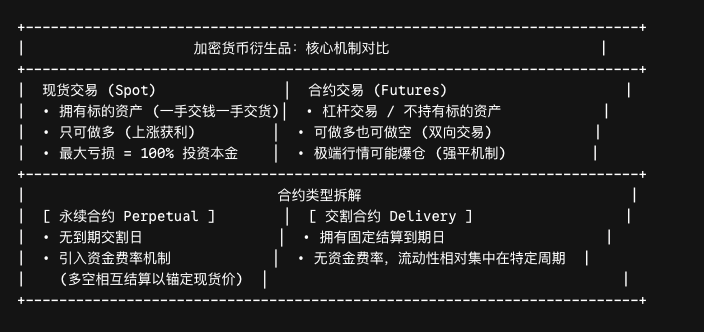
Spot trading is a direct exchange of money for an asset: you buy and hold a cryptocurrency, profiting if its price rises and losing if it falls. Futures trading uses margin and leverage without requiring you to hold the underlying asset; you instead take a position based on whether you expect the price to rise or fall.
The most fundamental difference is that a spot position can lose at most the capital invested, whereas leverage can amplify losses in futures trading and trigger liquidation. In some circumstances, the loss may even exceed the initial margin committed.
Perpetual Futures vs Delivery Futures
Crypto futures generally fall into two categories:
Perpetual futures are the market's dominant product and account for more than 90% of Bitcoin futures trading volume. They have no expiration date, so a position can remain open indefinitely as long as the account has sufficient margin. To keep contract prices aligned with spot prices, perpetual futures use a funding-rate mechanism: when the contract trades above spot, long positions pay short positions; when it trades below spot, short positions pay long positions. Funding payments are exchanged directly between the two sides rather than collected by the platform.
Delivery futures have a fixed expiration and settlement date. The contract closes automatically when it expires. These products are more suitable for event-driven trades with a defined time horizon, although they offer less flexibility.
For beginners, perpetual futures are generally easier to start with because they are flexible and governed by relatively simple rules.
Essential Concepts at a Glance
Leverage determines how large a position you can control with a given amount of capital. With 5x leverage, for example, 100 USDT can control a 500 USDT position, while both profits and losses are magnified fivefold. Margin is the risk capital committed when you open a position. If it becomes insufficient, the position may be forcibly liquidated.
Liquidation occurs when the market price reaches the liquidation price and the system closes the position to prevent further losses. Going long means expecting the price to rise, while going short means expecting it to fall—this ability to trade in either direction is a fundamental structural difference between futures and spot markets.
Take-profit and stop-loss orders are the most important protective tools in futures trading. They allow you to lock in gains or cap maximum losses in advance. The funding rate is a periodic settlement mechanism unique to perpetual futures, and its cost must be considered when holding positions for an extended period.
Complete Your First Futures Trade in Four Steps
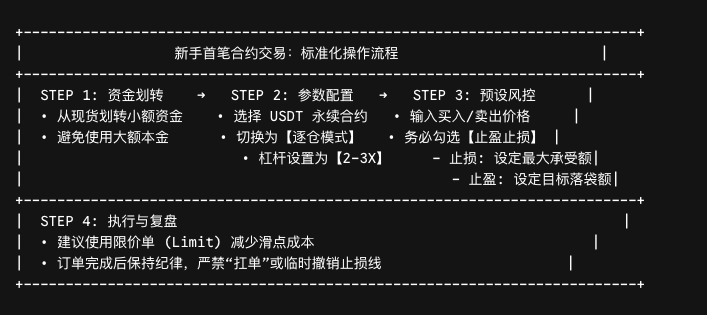
Step 1: Transfer Funds
Transfer a small amount from your spot account to your futures account. Beginners should use only a minimal amount at first; the objective is to learn the workflow, not to maximize profit.
Step 2: Choose the Contract and Margin Mode
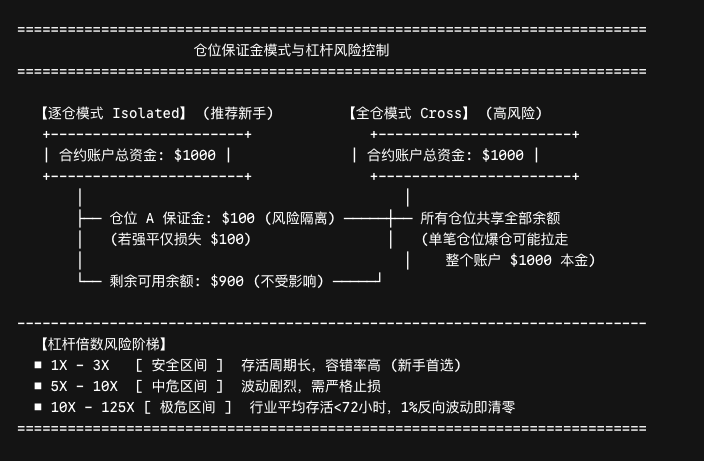
Choose a USDT-margined perpetual contract, which settles in USDT and is straightforward to calculate. Beginners should start with 1x–3x leverage instead of the maximum leverage of up to 125x that some platforms allow. Isolated margin is preferable to cross margin because it limits the risk of a position to the margin assigned to that trade, helping prevent one mistake from draining the entire account.
Step 3: Set Take-Profit and Stop-Loss Orders
This is the most critical step in futures trading. Set both a stop loss and a take profit when opening the position: the stop loss defines the maximum loss you are prepared to accept, while the take profit defines when gains should be realized. Trading futures without a stop loss is essentially gambling.
Step 4: Place the Order and Review the Trade
Choose to go long or short according to your market view. Beginners should generally use limit orders to avoid the slippage that can occur with market orders. Whether the trade wins or loses, review it afterward rather than rushing immediately into the next position.
Seven Survival Rules for Beginners
Use isolated margin, not cross margin. This is the first line of defense for your account. With cross margin, a single mistake can drain the entire futures balance.
Always set a stop loss. Trading without one leaves risk uncontrolled. Placing the stop beyond a key support or resistance level can reduce the chance of normal short-term volatility triggering it prematurely.
Start with low leverage. Beginners should generally stay at or below 2x–3x. Industry data indicates that traders using leverage above 10x survive for only 72 hours on average, whereas those using 2x–5x may preserve their capital for up to six months.
Never commit the entire account. Going all in with leverage is equivalent to risking everything; one extreme market move can reduce the account to zero.
Do not hold losing positions blindly or trade against the trend. Waiting indefinitely for a rebound while losses grow is a common beginner mistake. Spot holdings can fall to zero, but futures positions can continue consuming margin. Shorting a clear uptrend or attempting to catch a falling market is a frequent cause of liquidation.
Understand funding costs. Holding perpetual futures may require you to pay or allow you to receive funding. When the rate is positive, longs pay shorts, so maintaining a long position can gradually erode profit.
Be prepared to lose all committed capital. Futures trading is not a shortcut to wealth. Moving from persistent losses to consistent profitability often requires years of testing and discipline.
Five Major Risks of Futures Trading
Market volatility is the most direct risk. Sharp crypto price movements can trigger liquidation within a short period, especially during wick events when the price briefly deviates far from its normal range.
Leverage is fundamentally a risk multiplier. High leverage magnifies not only gains but also losses in equal proportion. At 100x leverage, a price move of slightly more than 1% can be enough to liquidate a position.
Liquidation risk arises when the market reaches the liquidation price and may result in the complete loss of the position's margin.
Liquidity risk is particularly significant in contracts for smaller tokens. Insufficient market depth can cause slippage, meaning the actual execution price differs substantially from the expected price.
Operational risk includes trading without a stop loss, putting the entire account into one position, and holding against the trend. Statistics suggest that most futures liquidations result not from an incorrect market view alone but from missing risk controls.
Frequently Asked Questions (FAQ)
Q1: Is futures trading suitable for beginners?
Beginners can participate, but only with extreme caution. The essential conditions are understanding that leverage multiplies losses, being willing to control risk with stop-loss orders, and not treating futures as a quick path to wealth. Industry data showing an average user lifespan of about six months reflects the product's high-risk nature.
Q2: How much leverage should a beginner use?
Generally no more than 2x–3x. The probability of liquidation with high leverage above 10x is much greater than with low leverage. In practice, high leverage often accelerates losses rather than merely amplifying returns. Building experience with low leverage is far more important than chasing short-term windfalls.
Q3: What is the difference between isolated and cross margin?
Isolated margin limits the risk of one position to the margin assigned to it, so liquidation affects only the funds allocated to that position. Cross margin uses the entire available futures-account balance as shared margin for all positions, meaning one error can drain the whole account. Isolated margin is strongly recommended for beginners.
Q4: Where should I place a stop loss?
A stop loss is usually placed just beyond a key support or resistance level so that ordinary market noise is less likely to trigger it prematurely. For a long position, for example, it can be placed slightly below a recent support level. At the same time, the loss on a single trade should generally remain below 1%–2% of total capital.
Further reading: Complete Guide to Futures Trading: From Basics to Risk Management | Introduction to Crypto Technical Analysis: From Candlesticks to Trading Systems | Leverage Trading Explained: Amplifying Both Returns and Risk | What Is Futures Liquidation? Forced Liquidation and Price Calculations | Futures Take-Profit and Stop-Loss Guide: Protecting Your Gains | Cross vs Isolated Margin: Differences and How to Choose | Futures Position Management: Kelly Criterion and Scaling Strategies | Common Futures Trading Mistakes: 10 Errors Beginners Make
Recommended reading: Crypto Trading Psychology: From Emotional Control to Discipline | Complete Guide to Crypto Trading Strategies
Recommended
View more