How to Buy Ethereum (ETH): The Complete 2026 Guide
You can usually buy Ethereum (ETH) through a cryptocurrency trading platform: create an account, complete any required identity verification, fund the account, and place an order in an ETH trading pair. After buying, decide whether to keep the ETH on the platform or transfer it to a self-custody wallet. Ethereum's official resources also list exchanges as one of the main ways to obtain ETH.
Note: Trading-platform features, fees, and regional rules can change. Any current Hotcoin procedures and fees discussed here are based on official information that could be verified in August 2026.
Before Buying ETH, Choose the Right Purchase Method
For a first ETH purchase, answer three questions first: what funds will you use, where will you hold the ETH afterward, and will you need to transfer it to an external wallet? Trading platforms combine account management, funding, spot trading, and asset management in one environment, making them a practical starting point for new buyers.
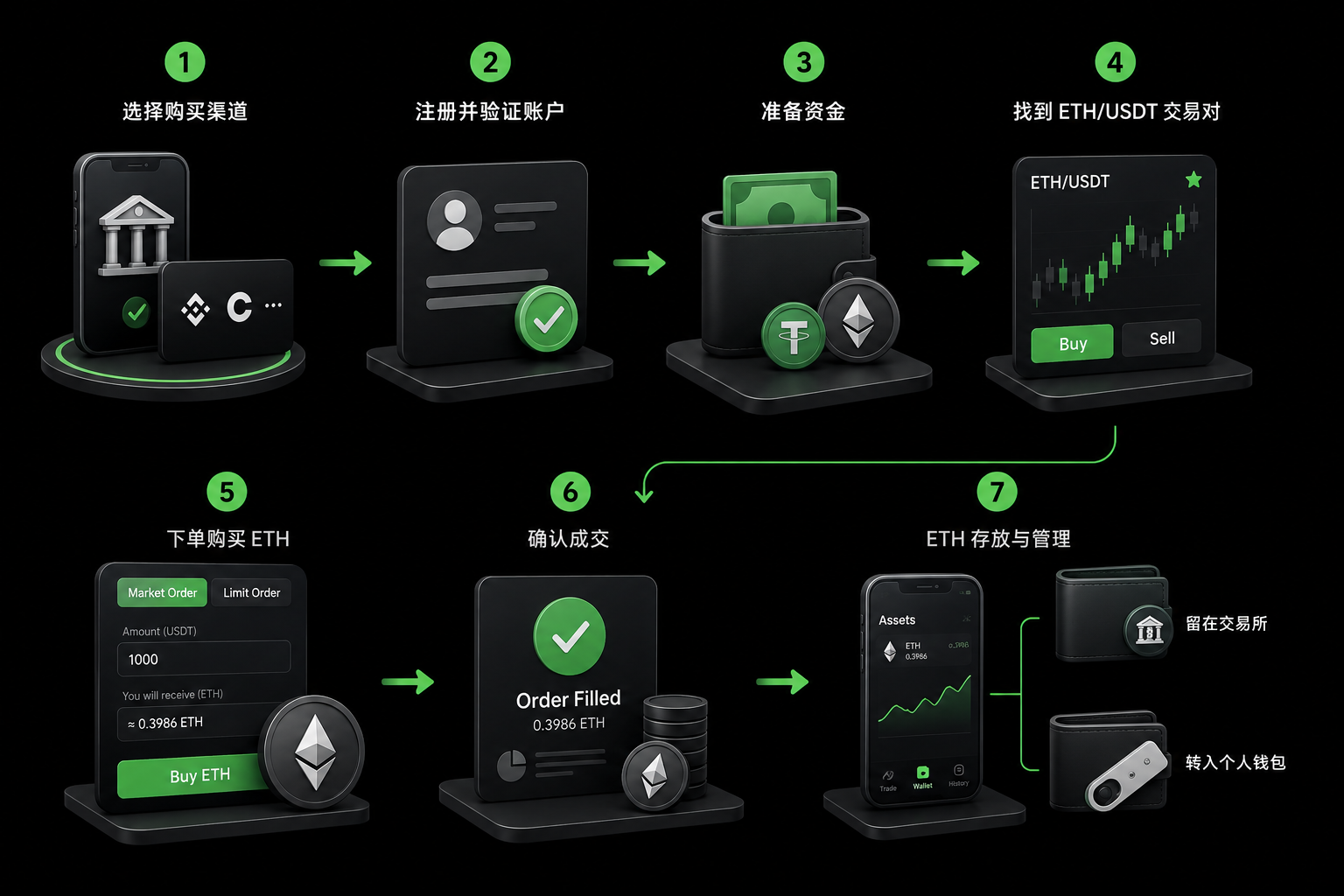
The process can be summarized as: choose a purchase channel → register an account → verify your identity → prepare funds → select an ETH pair → place an order → check your assets.
You do not need to begin with complex DeFi, cross-chain, or smart-contract operations. Complete the basic purchase first, then learn about wallets, gas, and on-chain transactions to reduce the chance of operational mistakes.
What Are the Ways to Buy ETH?
Common ways to obtain ETH include centralized exchanges, in-wallet purchase services, and decentralized exchanges. They differ mainly in difficulty, funding methods, control of assets, and fee structure, while availability also depends on your region.
For a first ETH purchase, a centralized trading platform is often the easiest route to understand. The main steps are account verification, funding, order placement, and subsequent storage.
Step 1: Register a Hotcoin Account and Configure Security
If you choose Hotcoin, register and sign in only through an official Hotcoin channel. Configure account-security measures before depositing funds or trading. Hotcoin's spot interface provides trading pairs such as ETH/USDT.
When registering and signing in:
- Access Hotcoin only through official channels.
- Use a strong, unique password.
- Enable the security verification options available to your account.
- Never disclose your password, verification codes, private keys, or seed phrase.
- Do not sign in through links sent by strangers.
You can enter the platform through the official Hotcoin website.
Step 2: Complete Identity Verification as Required
Whether KYC is required, and which features become available afterward, depends on your account page, location, and Hotcoin's current rules. Identity verification confirms the account holder's identity and can enable relevant trading or funding features under applicable requirements.
The process may change as product pages are updated, so follow the instructions currently displayed. If a document cannot be recognized, details do not match, or verification fails, review the on-screen message and resubmit instead of repeatedly creating new accounts.
Step 3: Prepare Funds to Buy ETH
Before buying ETH, prepare funds that can be used for trading. These may include USDT you already hold, another digital asset that can be converted into ETH, or fiat funds supported in your region and by the platform.
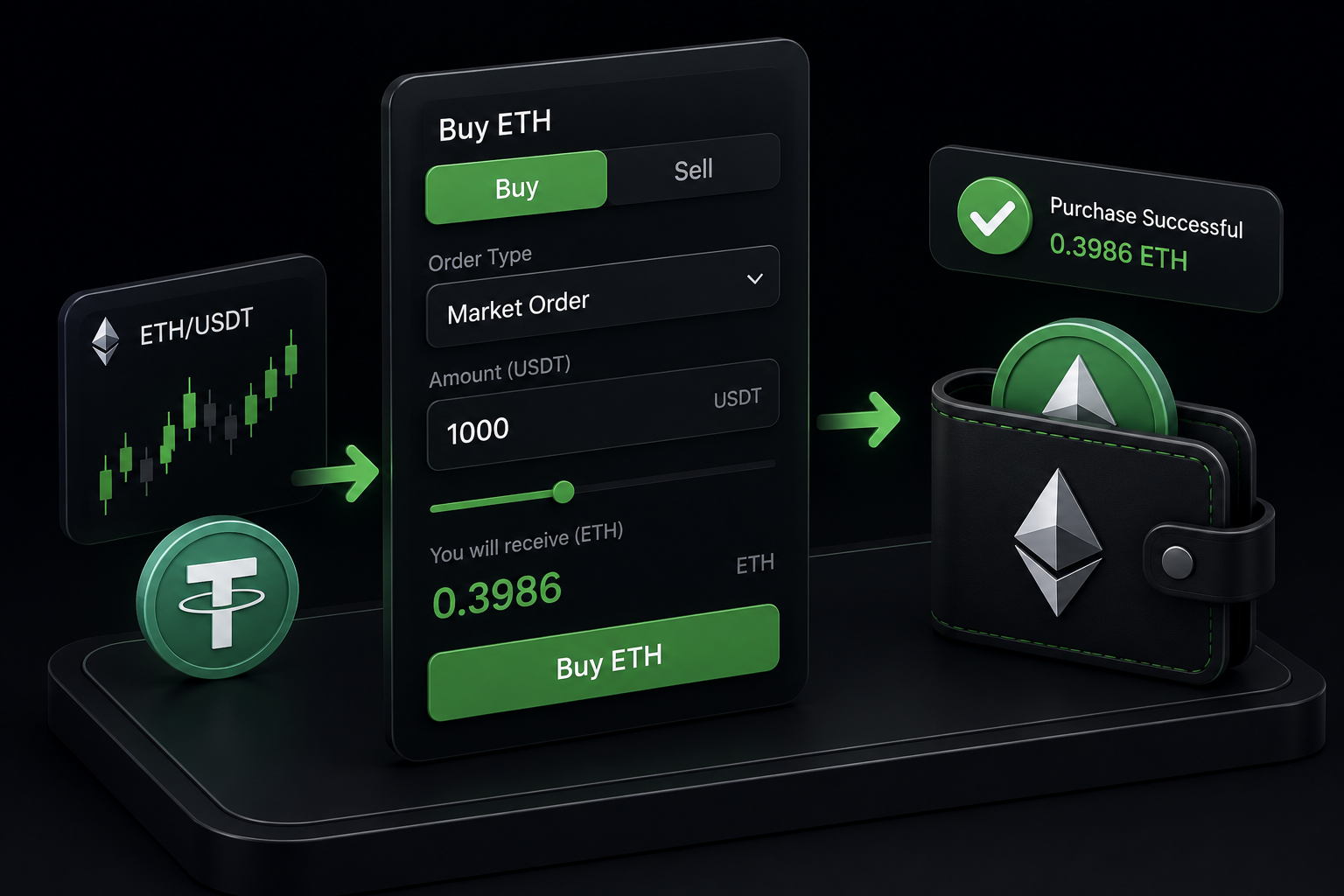
If you already have USDT, the path is generally select ETH/USDT → use USDT to buy ETH. Hotcoin's spot market supports pairs such as ETH/USDT and provides buy and sell controls, an order book, market data, and order history.
Keep two charges separate: the spot trading fee for buying ETH on the platform and the Ethereum network gas fee for a later on-chain transfer are not the same. Buying ETH with USDT on a platform does not mean every spot trade carries an additional Ethereum mainnet gas fee.
Step 4: Find the ETH/USDT Trading Pair
Once the funds are ready, enter Hotcoin's spot market and search for ETH/USDT. Other pairs, such as BTC/USDT, can also be found there.
The trading page generally displays the current ETH price, buy and sell areas, the order book, a candlestick or price chart, open orders, and order history. On a first trade, confirm:
- The pair is ETH/USDT.
- The direction is buy rather than sell.
- The selected order type is correct.
- The ETH quantity or spending amount is correct.
- The estimated total execution cost is acceptable.
For detailed order instructions, read the ETH/USDT Trading Guide: Ethereum Spot Trading Tutorial.
Step 5: Choose a Market Order or Limit Order
A market order prioritizes immediate execution. After submission, it executes against available orders at current market prices, so the final fill price can differ slightly from the price shown at the instant you submit it.
A limit order lets you specify an acceptable price first. It fills only when the market reaches that price and matching liquidity is available in the order book.
Neither is always better. Consider a market order when immediate execution matters more, or a limit order when controlling the execution price matters more. Available order types and their exact rules should always be checked on the live trading page.
Step 6: Enter the Purchase Amount or ETH Quantity
After selecting an order type, enter the amount you want to spend or the quantity of ETH you want to buy. A simple estimate is:
ETH purchasable ≈ USDT allocated to the purchase ÷ ETH execution price
The following is only a calculation example and does not represent Hotcoin's current rules. If you spend 500 USDT at an assumed execution price of 2,000 USDT per ETH, before fees and price changes:
500 ÷ 2,000 = 0.25 ETH
You therefore do not need enough funds to buy a whole ETH. Actual results also depend on trading fees, execution prices, and market movements.
Step 7: Confirm the Order and Check Whether ETH Arrived
Before submitting, review the trading pair, buy direction, order type, price, quantity or amount, and available account balance.
After execution, check your ETH balance on the assets page. Do not assume the purchase is complete merely because the order was submitted. For a limit order, submission and execution are separate states. If it remains open, inspect the active order; if it has filled, inspect the trade record and asset balance.
How Much Money Do You Need to Buy ETH?
You do not need to buy one whole ETH. The quantity you can purchase depends on your available funds, the current ETH execution price, the platform's minimum order requirement, and trading fees.
Before ordering, check the current ETH/USDT page, minimum order amount or quantity, available balance, and applicable fee rate. A permanent fixed "minimum purchase amount" is not reliable because trading rules can change.
How Are ETH Purchase Fees Calculated?
At minimum, distinguish the platform's spot trading fee from Ethereum network gas fees. When this article was verified, Hotcoin's official help center listed a standard spot trading fee of 0.2% for both limit and market orders, while VIP users could receive different rates by tier. Check the actual rate in "My Fee Rates" in the app or on the web VIP page.
Trading fee = executed amount × actual fee rate
The following is only an example. If the executed amount is 500 USDT and the applicable rate is 0.2%, the fee is 500 × 0.2% = 1 USDT. The amount displayed in the completed order remains authoritative.
To understand Ethereum's on-chain costs, read How Is Ethereum Gas Calculated? A Fee-Saving Guide.
After Buying ETH, Must You Withdraw It to a Wallet?
Not necessarily. If you only want to buy, hold, or continue spot trading, you can initially keep ETH in your platform account. Consider a self-custody wallet only when you need to use Ethereum applications, control the assets directly, interact with DeFi, or make on-chain transfers.
Self-custody means taking responsibility for security. An incorrect wallet address can cause a loss, while exposure of a private key or seed phrase can lead to theft. You do not need to withdraw immediately merely to appear more experienced; first determine why you need a wallet.
What Is the Difference Between Platform Fees and Gas Fees?
A platform trading fee is charged for completing a spot trade on a trading platform. An Ethereum gas fee is a network fee incurred when executing a transaction or smart-contract operation on Ethereum, and ETH is the network's native asset used to pay this cost.
If you are only completing your first spot purchase of ETH on a platform, do not confuse gas fees with spot trading fees.
Can You Use Dollar-Cost Averaging After Buying ETH?
You can study dollar-cost averaging, but whether to use it and how to buy ETH are separate decisions. DCA makes repeated purchases at a fixed amount and interval. It can reduce reliance on choosing one market entry point, but it cannot remove ETH price risk or guarantee a profit.
If you plan to buy a fixed amount monthly, track total capital invested, total ETH accumulated, and average cost rather than assuming a future return. See ETH DCA Strategy: The Long-Term Results of Monthly ETH Purchases.
Should You Buy BTC or ETH? Decide What to Buy First
If you have not decided between BTC and ETH, resolve what to buy before deciding how to buy it. BTC is the Bitcoin network's native asset and is often discussed as a scarce digital asset. ETH is Ethereum's native asset; in addition to being traded, it pays network fees and is connected to staking and the on-chain ecosystem.
There is no universal answer. Compare scarcity and monetary properties, smart contracts and on-chain applications, use cases, the volatility you can tolerate, and whether you have a specific on-chain need. For a fuller comparison, read Buy BTC or ETH? A 2025 Investment Comparison.
Common Mistakes When Buying ETH for the First Time
For a first ETH purchase, the important question is not only how to buy, but also what not to do afterward.
Treating Ethereum and ETH as the Same Thing
Ethereum is a blockchain network; ETH is its native asset. ETH pays Ethereum transaction fees and also participates in the network's security mechanism.
Failing to Check the ETH/USDT Pair
If you intend to use USDT to buy ETH, confirm that the page is ETH/USDT rather than another ETH-related trading pair.
Misunderstanding Order Status
This is especially important for limit orders: "order submitted" does not mean "order filled."
Confusing Trading Fees with Gas Fees
Platform spot trades and Ethereum on-chain transactions incur fees at different layers.
Starting Complex On-Chain Operations Immediately
If this is your first ETH purchase, you do not need to begin with complex DeFi, cross-chain, or smart-contract operations.
Failing to Confirm the Withdrawal Network
Before withdrawing to an external wallet, confirm that the receiving wallet supports the selected network and asset type.
Sharing a Seed Phrase or Private Key
Never give your private key or seed phrase to a stranger who claims they can recover assets, fix your wallet, or verify it for you.
Complete Checklist for Your First ETH Purchase
- Confirm that ETH is the asset you actually need.
- Choose a purchase channel available in your location.
- Register through an official channel.
- Configure account security measures.
- Complete identity verification as required.
- Prepare fiat funds, USDT, or another supported source of funds.
- Find the correct pair, such as ETH/USDT.
- Confirm the buy direction.
- Choose a market or limit order.
- Review the price, amount, quantity, and fee.
- Submit the order.
- Check whether it actually filled.
- Confirm that ETH appears in the account balance.
- If withdrawing, separately confirm the wallet address and network.
At this point, the core task of buying ETH is complete. Whether you later trade ETH/USDT, use on-chain applications, apply DCA, or compare assets should depend on your actual needs.
Frequently Asked Questions
Must I Buy One Whole ETH?
No. ETH can be purchased in the quantities or spending amounts supported by the platform. Check the live trading page for the current minimum order quantity or amount.
Do I Need a Wallet to Buy ETH?
Not necessarily. After buying through a trading platform, you can initially keep ETH in the platform account. Consider self-custody only when you need direct asset control or on-chain applications.
Must I Pay a Gas Fee to Buy ETH?
Not necessarily. For an ETH spot trade within a platform, focus on the platform trading fee. A later Ethereum transfer or smart-contract operation may incur a network gas fee.
Are ETH and WETH the Same?
No. ETH is Ethereum's native asset, while WETH represents ETH in ERC-20 form for applications that require ERC-20 compatibility. You do not need to convert ETH into WETH simply to make a first ETH purchase.
Should a First-Time Buyer Use a Market or Limit Order?
They serve different needs. A market order emphasizes quick execution; a limit order emphasizes price control but may not fill immediately. Understand how both execute, then choose according to your priorities.
Risk Warning
ETH is a highly volatile crypto asset. Its price can move sharply over a short period, and buyers may lose part or all of the money committed.
This article explains the ETH purchase process, trading concepts, and operational precautions. It is not investment advice and does not promise returns. Do not commit more than you can afford to lose based on a price forecast, market opinion, or short-term move.
For an on-chain transfer, carefully verify the wallet address, network, and asset type. Once confirmed, a blockchain transaction generally cannot be reversed like a conventional payment.
If You Plan to Make Your First BTC Purchase on Hotcoin
Continue with Hotcoin's Guide to Your First BTC Purchase.
Buy Crypto Assets with Hotcoin
If you understand the process and are ready to begin using Hotcoin, register through the official entry point: Hotcoin registration and trading portal.
Recommended
View more