PancakeSwap: The DeFi Leader on BNB Chain
PancakeSwap is a decentralized trading protocol that grew up around BNB Chain. It first rose to prominence through automated market making (AMM) and low-cost on-chain trading, and today it is a DeFi ecosystem spanning multiple public blockchains. To understand PancakeSwap, it helps to look at why it was created, how its trading works, how V2, V3 and Infinity evolved, and what risks ordinary users should keep in mind.
1. What is PancakeSwap?
PancakeSwap is a decentralized exchange (DEX) protocol. By connecting their own crypto wallet, users can swap tokens, provide liquidity and take part in other DeFi products on-chain.
It was originally built inside the BNB Chain ecosystem and uses an AMM mechanism.
Unlike a traditional centralized exchange, PancakeSwap does not rely on an order book to match buyers and sellers. Token swaps are completed through liquidity pools instead.
In a BNB/USDT liquidity pool, for example, both BNB and USDT are held at the same time.
When a user buys BNB with USDT:
User pays USDT → the liquidity pool receives USDT → the user receives BNB
The amounts of the two assets in the pool change, and the price changes with them.
This is the most basic way an AMM DEX operates.
What makes PancakeSwap notable is that it has built on this foundation to develop multiple AMM versions, multi-chain deployment, aggregated routing, liquidity incentives and other DeFi products.
2. Why did PancakeSwap choose BNB Chain at first?
PancakeSwap's development is closely tied to the BNB Chain ecosystem.
One practical problem faced early DeFi users was this:
On-chain trading costs on Ethereum were high, while ordinary users needed a lower-cost trading environment.
BNB Chain offered certain advantages in transaction cost and confirmation speed, which made it an important network for a large number of DeFi applications.
It was in this environment that PancakeSwap rapidly expanded its user base.
Through lower transaction costs, liquidity mining and CAKE incentives, it attracted users and liquidity, gradually becoming one of the most representative DeFi protocols on BNB Chain.
This early advantage also shaped PancakeSwap's product positioning:
Low-barrier trading + a rich set of DeFi products + a strong connection to the BNB Chain ecosystem.
That said, it is no longer accurate to think of PancakeSwap simply as "a DEX on BNB Chain."
As of 2026, PancakeSwap has expanded to multiple blockchain networks and continues to develop multi-chain trading and liquidity infrastructure.
3. What is PancakeSwap's core trading mechanism?
PancakeSwap's classic trading mechanism is built on AMM liquidity pools.
A traditional exchange relies on:
Buy orders + sell orders → order matching → a trade is filled
An AMM is closer to:
Liquidity Pool → Pricing Formula → Swap
Users interact directly with the liquidity pool.
Suppose the pool holds:
10 BNB + 6,000 USDT
If someone buys BNB with USDT, then after the trade:
The USDT in the pool increases
The BNB in the pool decreases
The in-pool price of BNB changes
So the user's own trade affects the state of the pool.
This is the biggest difference between an AMM and a fixed exchange rate.
4. What is the difference between PancakeSwap V2 and V3?
PancakeSwap does not use only one liquidity model.
Understanding the difference between V2 and V3 is the key to understanding how PancakeSwap evolved.
1. V2: the classic AMM
V2 follows the classic AMM design.
Users supply tokens to a liquidity pool, traders complete swaps through that pool, and LPs earn trading fees and other returns according to the pool's rules.
The defining feature of this model is:
Simple, easy to understand, with a relatively low barrier to entry.
One problem with traditional AMMs, however, is that capital may be spread across a large number of price ranges that are rarely traded, which limits capital efficiency.
2. V3: concentrated liquidity
V3 introduced concentrated liquidity.
LPs can choose a specific price range in which to provide liquidity, instead of spreading their capital evenly across the entire price range.
If an LP expects a given pair to trade mainly within one particular price range in the future, for example, they can concentrate their capital in that area.
This improves how efficiently capital is used within the effective price range.
But it also creates a new problem:
LPs have to manage price ranges.
If the market price moves outside the range that was set, the related liquidity may no longer sit in the active trading range, so it cannot keep earning trading fees the way it does while the price stays inside the range.
This means V3 is more capital-efficient, but also more complex for LPs to manage.
5. What is PancakeSwap Infinity?
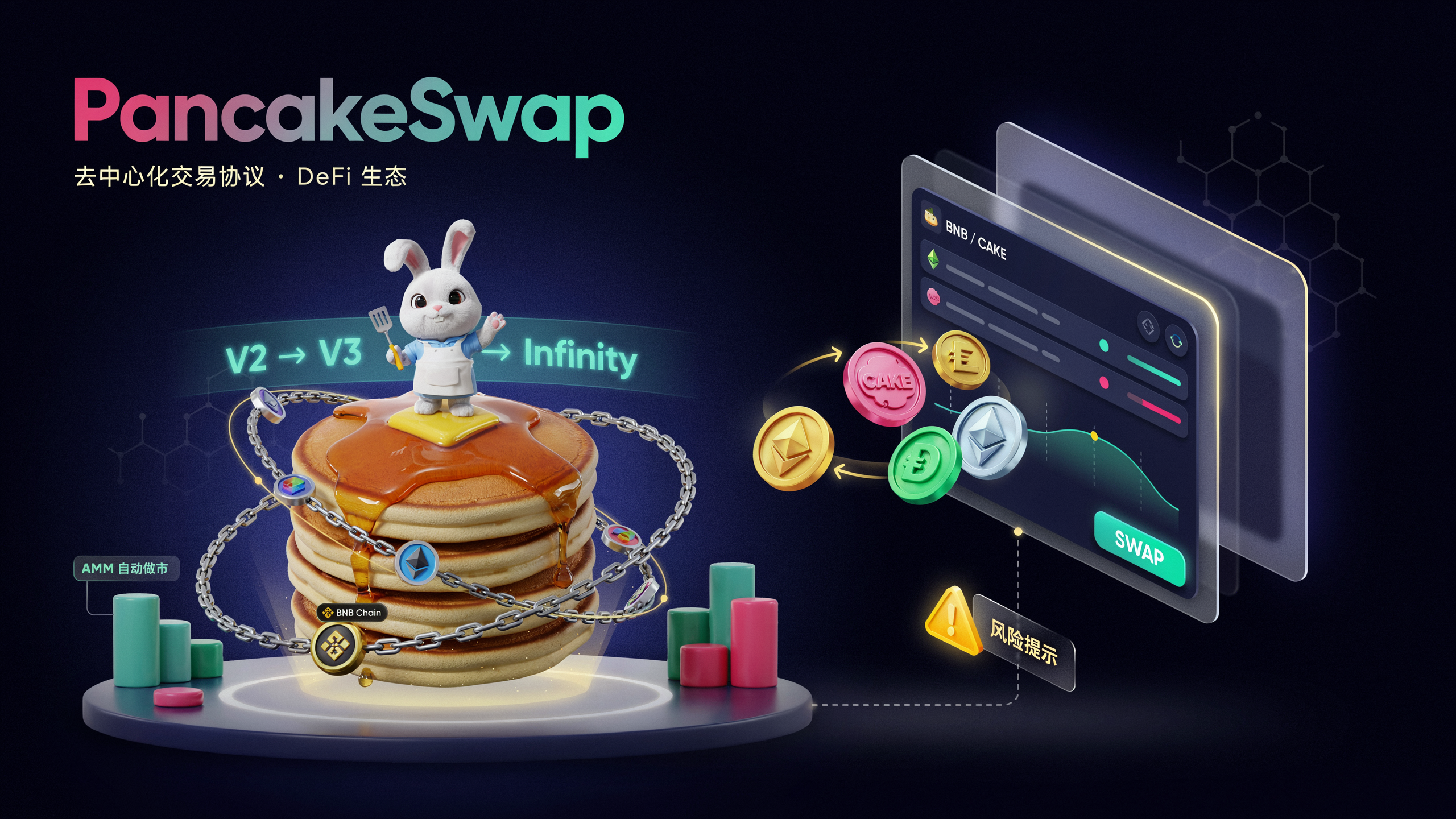
If V2 and V3 represent PancakeSwap's continuous optimization of the AMM mechanism, Infinity goes further and changes the architecture of the liquidity pool itself.
One of the core ideas behind PancakeSwap Infinity is a more modular Pool architecture that lets developers use different Pool types and Hooks to extend trading and liquidity mechanisms.
Put simply:
Traditional AMM:
Fixed rules → create a Pool → users trade
Infinity:
Pool + Hooks + custom logic → more flexible trading and liquidity design
Hooks let developers add custom logic at specific points in a pool's lifecycle.
This means a liquidity pool is no longer just "a place to store tokens"; it can become a more flexible on-chain financial module.
PancakeSwap has continued to advance Infinity through 2026, and its official materials indicate that Infinity has already built a considerable trading and Hooked Pool ecosystem.
6. What does PancakeSwap's Smart Router do?
When trading on a DEX, users often face one question:
Which pool gives me the best trade?
Say you want to buy BNB with USDT.
There may be a route such as:
USDT → BNB
There may also be:
USDT → USDC → BNB
Different liquidity pools may even quote different prices and depths.
Finding the optimal path on your own would be very complicated for an ordinary user.
PancakeSwap's Smart Router exists to solve this kind of problem.
Based on available liquidity and trading paths, it looks for a more suitable way to execute across different liquidity sources, and it supports mechanisms such as multi-hop and split routing.
So what the user sees may be only:
Input token → Output token → Confirm
while behind the scenes a much more complex routing calculation may already have been completed.
This is also an important sign of how modern DEXs have gradually evolved from a "single AMM" into "trading and liquidity infrastructure."
7. Why is the cost of a PancakeSwap trade affected by so many factors?
Many new users think of DEX trading costs simply as "fees."
In practice, a single PancakeSwap trade may involve several cost factors:
1. Trading Fee
The trading pool charges a swap fee according to its specific rules.
Different pools and different AMM mechanisms may have different fee rates.
2. Price Impact
Your own trade can change the asset ratio in the liquidity pool.
The larger the trade amount relative to the pool's depth, the more noticeable the price impact usually is.
3. Slippage
The actual fill price may differ from the expected price shown when the trade was submitted.
4. Network Fee
On-chain transactions also require paying Gas on the relevant network.
So judging whether a DEX trade is "cheap" cannot be based on the trading fee alone.
A more reasonable calculation is:
Actual trading cost ≈ Trading Fee + Price Impact + Slippage cost + Gas, and so on
The final result can differ across networks, pools and trade sizes.
8. How do PancakeSwap LPs make money?
LPs, or Liquidity Providers, are important participants in the PancakeSwap ecosystem.
Users can supply the relevant tokens to eligible liquidity pools.
For example:
BNB + USDT → BNB/USDT Pool
When other users trade through that pool, trading fees are generated.
Eligible LPs can receive the corresponding fee income according to the specific pool's rules.
Some liquidity pools may also offer additional Farming incentives.
So an LP's potential return can be summarized as:
Trading fees + additional incentives
But there is a very important misconception here:
The fact that an LP receives fees does not mean the position will necessarily end up profitable.
That is because LPs also bear:
Token price volatility
Impermanent loss
Liquidity risk
Smart contract risk
Changes in incentives
Costs such as Gas
So you cannot judge whether an LP strategy is worth joining on the basis of "APR" or "fee income" alone.
9. What kind of token is CAKE for PancakeSwap?
CAKE is the core token of the PancakeSwap ecosystem.
It is used not only in some of PancakeSwap's ecosystem incentives and product mechanisms, but is also tied to governance, staking and similar functions.
As PancakeSwap's tokenomics has continued to be adjusted, the issuance, burn and supply mechanisms of CAKE have changed several times.
In 2026, PancakeSwap continued to run its CAKE supply contraction mechanism.
The official mid-2026 report showed that net supply had fallen for 34 consecutive months up to that point; in January 2026, CAKE's maximum supply cap was also adjusted from 450 million to 400 million.
But note this in particular:
A reduction in token supply does not mean the token price will necessarily rise.
CAKE's market price is still affected by market supply and demand, the broader crypto market environment, protocol usage, liquidity and investor expectations.
So when thinking about tokenomics, supply mechanisms and market price should be considered separately.
10. Is PancakeSwap still just a DEX today?
No.
This is a very important point when understanding PancakeSwap's current positioning.
The early impression of PancakeSwap was mainly:
Swap + Liquidity + Farming
Today's PancakeSwap has expanded into a much richer product line.
It includes:
Swap
Liquidity
Farming
Syrup Pools
Perpetuals
Prediction
IFO
Multi-chain trading
PancakeSwap X
Infinity
Tokenized Assets, and more
In 2026, PancakeSwap disclosed officially that its ecosystem covers more than 10 chains, and it continues to expand on-chain asset trading and cross-chain liquidity. In the first half of 2026, it also focused on RWA, AI tools and new Perpetuals trading infrastructure.
So a more accurate understanding is:
PancakeSwap has grown from a BNB Chain AMM into a multi-chain DeFi trading and liquidity ecosystem.
11. What is PancakeSwap X?
PancakeSwap X can be understood as trading infrastructure that PancakeSwap introduced for more complex execution needs.
It emphasizes:
Best Execution + Routing + MEV Protection + Gasless Execution
Especially in scenarios such as multi-chain and Tokenized Assets trading, users do not necessarily have to find a specific liquidity pool themselves; they can complete asset trades through a more abstract trading entry point.
In 2026, PancakeSwap disclosed officially that PancakeSwap X is already used in scenarios such as Tokenized Assets trading, and it highlights experiences such as best-price routing, MEV protection and gas-free trading.
This also shows that PancakeSwap is moving beyond the "pool trading" of a traditional DEX toward:
Liquidity aggregation + smart routing + on-chain execution infrastructure.
12. Why has PancakeSwap stayed competitive over the long term?
PancakeSwap's competitiveness does not come from any single feature; several factors work together.
1. BNB Chain ecosystem advantage
PancakeSwap has long been deeply integrated with BNB Chain, creating a clear network effect in users, assets and liquidity.
2. User experience
PancakeSwap has always emphasized lowering the barrier to using DeFi.
For ordinary users, the simpler the trading page, the fewer technical details they need to understand to complete a swap.
3. A rich product line
Users can do more than swap: they can also take part in different types of DeFi activity such as liquidity, Farming and staking.
4. Multi-chain expansion
PancakeSwap no longer limits itself to a single network, but keeps expanding to more chains.
5. Liquidity infrastructure
Products such as Smart Router, Infinity and PancakeSwap X have gradually turned it from a pure trading application into liquidity infrastructure.
13. What should ordinary users watch out for most when using PancakeSwap?
PancakeSwap offers a relatively mature trading experience, but the basic risks of a DEX do not disappear just because the product interface is simple.
First, confirm the token contract address
Do not judge an asset only by its token name, logo or search results.
Tokens with the same name may correspond to completely different contracts.
Second, look at liquidity depth
If a pool has very low liquidity, even when the trading page quotes normally, a large trade may still cause a noticeable price impact.
Third, look at Price Impact
Do not only look at "how many tokens you will receive"; also watch the effect the trade itself has on the price.
Fourth, check Slippage
If slippage is set too low, the trade may fail; if set too high, you may accept an excessive deviation in fill price.
Fifth, pay attention to Token Approval
When trading certain tokens for the first time, the wallet may ask for a Token Approval.
Check the approval scope carefully, and do not grant unlimited allowances to contracts of unknown origin.
Sixth, confirm the network
If the network your wallet is currently connected to does not match the trading page, the trade may not complete properly, and it may even create unnecessary operational risk.
Seventh, do not assume something is safe just because it says "DEX"
PancakeSwap is trading infrastructure, but the specific tokens, contracts and third-party projects a user trades can still carry risk.
14. How is PancakeSwap different from a centralized exchange?
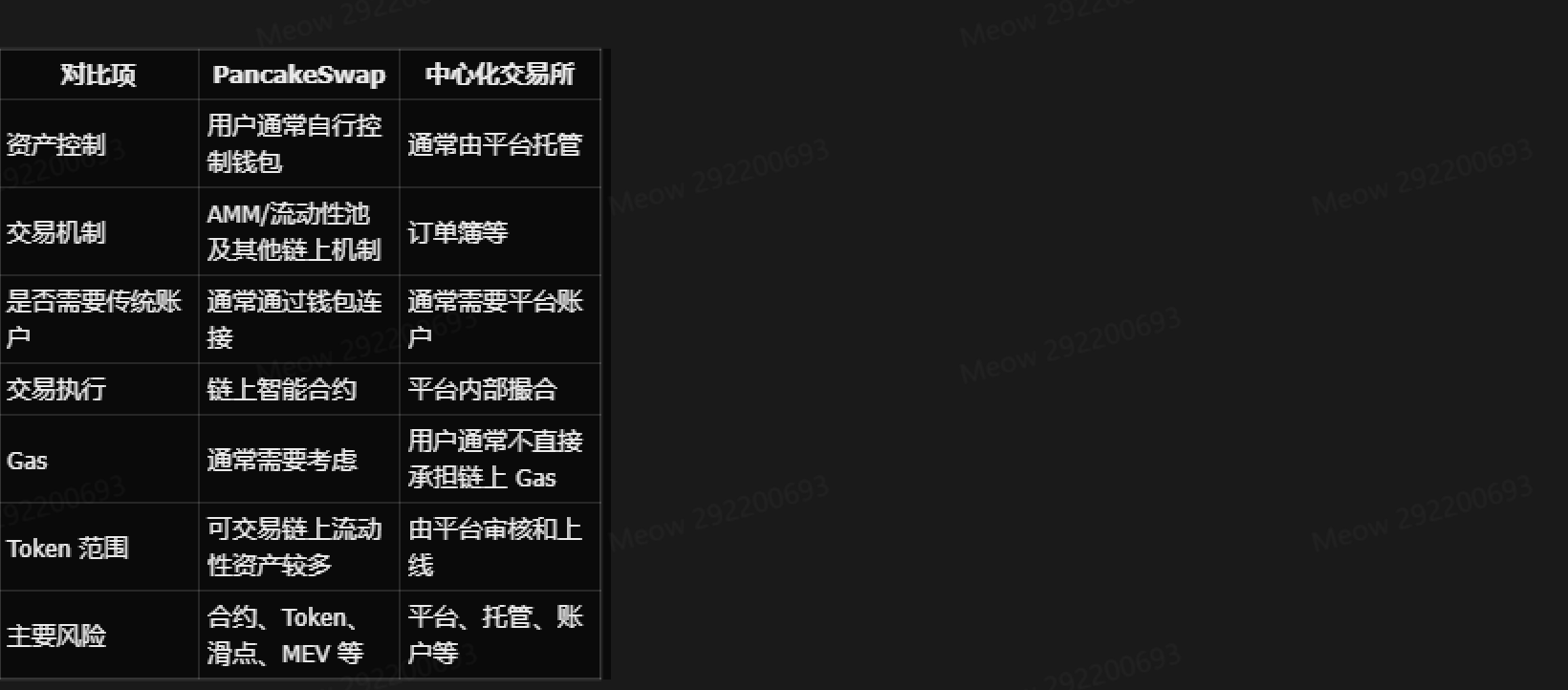
There is no simple answer to "which one is always better."
If users want direct control of their assets and on-chain token trading, a DEX has clear advantages; if they value convenience, order book trading and a mature account system more, a centralized exchange may suit them better.
15. What kind of users is PancakeSwap for?
PancakeSwap is a better fit for the following types of users:
First, users who already have an on-chain wallet.
They can connect their wallet directly and swap tokens.
Second, users who need to trade certain on-chain native assets.
Some assets may mainly circulate on DEXs.
Third, people who want to take part in DeFi liquidity.
For example, providing LP positions or joining Farming.
Fourth, people who want to understand how AMMs and DeFi work.
PancakeSwap's V2, V3 and Infinity can help users understand the differences between AMM architectures.
But if this is your first contact with crypto assets, you should first understand basic concepts such as wallets, networks, Gas, token contracts and transaction confirmation before trading for real.
FAQ: Common questions about PancakeSwap
What is PancakeSwap?
PancakeSwap is a decentralized trading protocol that initially grew around BNB Chain and offers DeFi functions such as token swaps, liquidity and Farming. It has now expanded into a multi-chain ecosystem.
Is PancakeSwap a centralized exchange?
No. PancakeSwap is a DEX. Users usually interact with on-chain smart contracts through their own wallet, rather than keeping assets in a custodial account on a centralized trading platform over the long term.
Why is PancakeSwap mainly associated with BNB Chain?
Because PancakeSwap grew up around the BNB Chain ecosystem from the start. Low transaction costs, relatively fast on-chain execution, and BNB Chain's rich ecosystem of assets and users provided important conditions for its early expansion.
What is the difference between PancakeSwap V2 and V3?
V2 is the classic AMM liquidity model with a relatively simple structure; V3 introduced concentrated liquidity, allowing LPs to provide liquidity within a specific price range and improving capital efficiency in that range, while also adding complexity to LP management.
What is CAKE in PancakeSwap?
CAKE is the core token of the PancakeSwap ecosystem, connected to ecosystem incentives, governance and some staking functions. Its supply and burn mechanisms are adjusted continuously according to protocol governance and the economic model.
Is trading on PancakeSwap safe?
PancakeSwap itself provides on-chain trading infrastructure, but "using a DEX" does not mean every token or smart contract is safe. Users still need to check the token contract, liquidity, trade price, approval scope and network.
Conclusion: PancakeSwap is no longer just an AMM on BNB Chain
PancakeSwap's development can be seen as a fairly clear path:
BNB Chain AMM → multiple liquidity models → multi-chain DEX → liquidity aggregation → DeFi ecosystem → on-chain trading infrastructure
PancakeSwap's early core strengths were simple, low-cost AMM trading and the BNB Chain ecosystem, and today it keeps expanding its trading and liquidity capabilities through products such as V3, Infinity, Smart Router and PancakeSwap X.
So the statement "PancakeSwap is the DeFi leader on BNB Chain" still captures its historical position, but given its product shape in 2026, a more accurate understanding is:
PancakeSwap is a DEX ecosystem that started on BNB Chain and has gradually grown into multi-chain DeFi trading and liquidity infrastructure.
For ordinary users, what really matters is not how many products PancakeSwap has, but the complete logic behind a single on-chain trade:
Wallet → Network → Token → Liquidity → Route → Price Impact → Slippage → Gas → Transaction
Once you understand this chain, you can genuinely make sense of how PancakeSwap trades, and better judge the cost and risk of an on-chain transaction.
Risk warning: DeFi and crypto asset trading carry relatively high risk. Using PancakeSwap may involve token price volatility, insufficient liquidity, smart contract vulnerabilities, malicious tokens, incorrect approvals, slippage, MEV, network fees and other on-chain execution risks. This article is for learning about blockchain and DeFi only and does not constitute any investment or trading advice.
Recommended
View more