
Should You Buy BTC or ETH? A 2025 Investment Comparison
If you value scarcity, liquidity, and a relatively straightforward long-term thesis, BTC may be a better fit. If you focus on smart-contract ecosystems, on-chain applications, and staking, ETH may be more attractive. Neither can simply be declared the “better buy.” The real distinction lies in the risks you are willing to accept, the value you prioritize, and how long you plan to hold.
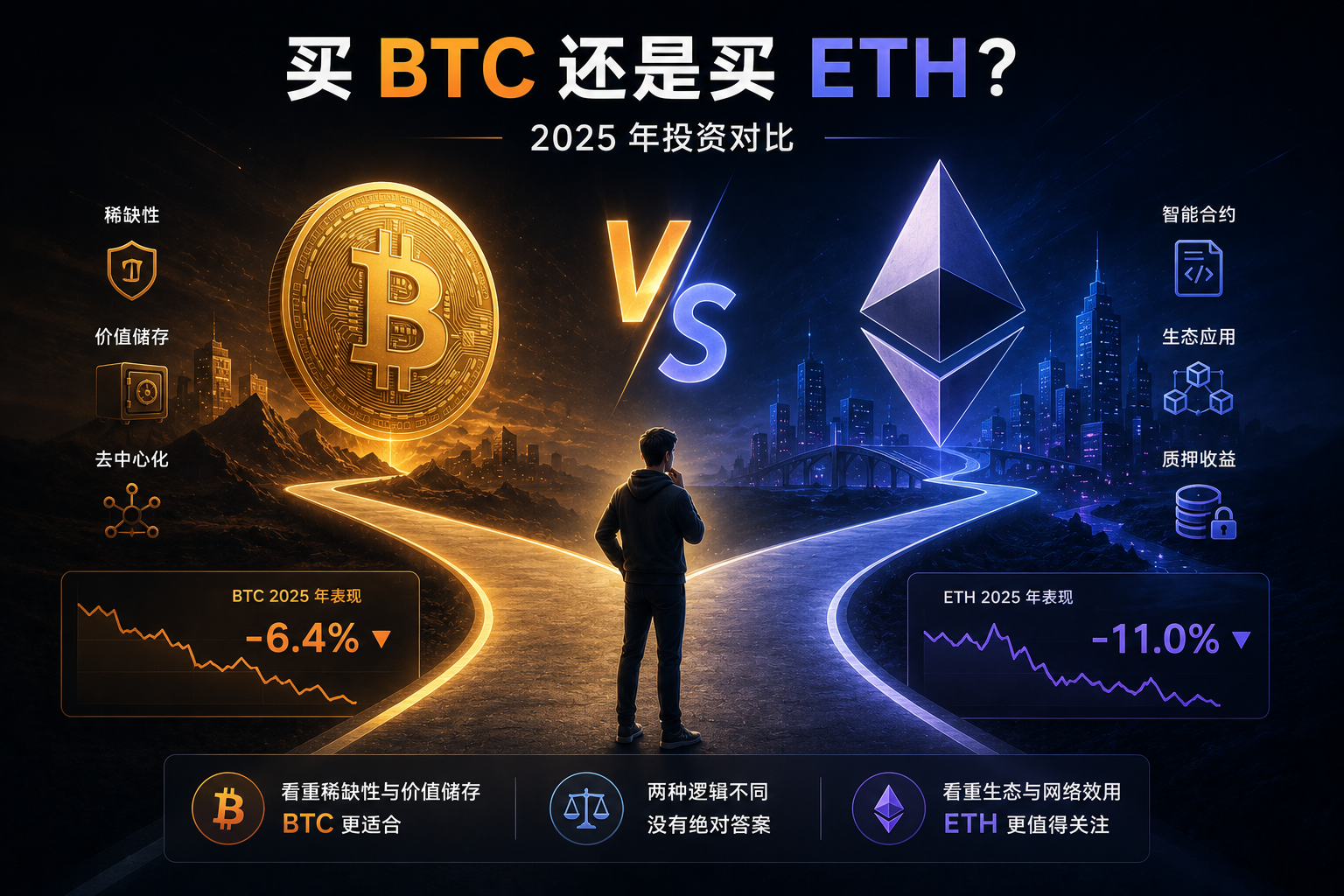
Their actual performance in 2025 also reminded investors that BTC and ETH, while often moving in the same direction, are not identical assets. Over the full year, BTC returned approximately -6.4%, while ETH returned around -11.0%, and both experienced substantial volatility. Rather than predicting which one must rise more, it is more useful to compare their asset roles, risks, sources of return, and suitability for different investment goals.
What Is the Fundamental Difference Between BTC and ETH?
BTC is closer to a crypto asset centered on scarcity and monetary properties. ETH derives more of its value from use of the Ethereum network, smart contracts, DeFi, stablecoins, and other on-chain applications. Put simply, buying BTC is more like taking exposure to a scarce digital asset. Buying ETH means both holding a crypto asset and taking a view on long-term demand for Ethereum as programmable blockchain infrastructure.
This is the most important difference between BTC and ETH. BTC has a relatively focused narrative: fixed supply, decentralization, digital gold, and store of value. ETH has a more complex thesis because it simultaneously serves as network gas, a staking asset, and the native asset of the Ethereum ecosystem. Both benefit from scarcity and network effects that interest long-term investors, but their sources of value are not identical.
For that reason, comparing BTC and ETH should not be reduced to asking how much one coin costs.
The more important question is:
What kind of value are you actually buying?
Why May BTC Suit Investors Who Prioritize Scarcity?
BTC's most obvious characteristic is its supply cap.
The Bitcoin protocol limits total supply to 21 million coins. New BTC enters circulation through block rewards, and new issuance gradually declines through the halving mechanism.
This predictability is an important part of the BTC investment thesis.
Investors do not have to estimate whether a large amount of new BTC will suddenly be created because its supply mechanism is embedded in the protocol.
This is why BTC is often described as “digital gold.”
However, one point requires emphasis:
A limited supply does not guarantee that the price will rise.
Asset prices depend on demand as well as supply. If future demand declines, BTC can still fall even when supply remains fixed.
A more precise summary of BTC's advantages is:
Relatively clear supply rules + large market size + deep liquidity + broad market recognition.
These qualities make it one of the first assets many investors consider when entering the crypto market.
Why May ETH Suit Investors Focused on the Blockchain Ecosystem?
ETH has a clearly different thesis from BTC.
Ethereum is a blockchain network that supports smart contracts and decentralized applications, while ETH is its native asset.
Users need ETH to pay gas when performing operations on Ethereum. Ethereum also uses a proof-of-stake consensus mechanism, allowing ETH to participate in staking.
ETH's value proposition therefore depends more directly on the Ethereum network itself.
If a growing number of the following operate within the Ethereum ecosystem:
- DeFi applications
- Stablecoins
- NFTs
- On-chain financial products
- Tokenized assets
- Layer 2 networks
- Smart contracts
the demand dynamics for ETH may also become more complex.
At the same time, this makes the ETH investment thesis harder to understand than BTC's.
You need to follow not only ETH itself, but also Ethereum's developer ecosystem, Layer 2 networks, on-chain activity, competing networks, and protocol upgrades.
In short:
BTC is closer to an “asset thesis.”
ETH is closer to an “asset + network thesis.”
How Do the Supply Mechanisms of BTC and ETH Differ?
Supply is one of the most important fundamental metrics for comparing BTC and ETH.
BTC:
Its maximum supply is 21 million coins.
ETH:
It does not have a fixed maximum supply like BTC. Issuance and burning are jointly determined by network rules.
After EIP-1559, Ethereum introduced a base-fee burn mechanism. ETH supply therefore does not simply increase at a fixed rate; it is affected by both issuance and the amount burned.
This means it is too simplistic to say:
“BTC has a supply cap, so it must be better than ETH.”
It is equally simplistic to say:
“ETH is burned, so ETH must be scarcer.”
The two assets have different supply mechanisms. What investors need to understand is:
BTC's core advantage is its supply cap and predictable monetary policy;
ETH uses issuance, staking, and fee burning to create a more dynamic supply mechanism.
This distinction is an important dividing line between the two investment theses.
Which Is Riskier, BTC or ETH?
In terms of asset-price volatility alone, BTC and ETH are both high-risk, highly volatile assets. However, ETH often reacts more strongly to market sentiment and ecosystem narratives.
The reason is straightforward.
BTC's investment thesis is relatively concentrated.
Market discussion about BTC usually revolves around:
macroeconomic liquidity, institutional allocation, supply scarcity, ETFs, halvings, and store-of-value demand.
ETH must contend with more variables:
Ethereum network usage, gas, Layer 2 activity, DeFi, staking, the developer ecosystem, competing blockchains, and protocol upgrades.
The more variables involved, the more complex the market's pricing process can become.
It is therefore inaccurate to reduce the comparison to:
BTC = safe
ETH = dangerous
A better description is:
BTC has a relatively simple investment thesis but still carries substantial price volatility. ETH has more complex sources of value, so investors must understand more variables.
Which Has Higher Long-Term Return Potential, BTC or ETH?
There is no reliable way to determine in advance whether BTC or ETH will deliver the higher long-term return.
Historical performance cannot be directly projected into the future either.
Still, 2025 provides a useful reference point.
Based on full-year price performance:
2025 was not a year in which buying ETH automatically meant outperforming BTC.
In fact, both assets saw substantial rallies and drawdowns during the year, and both ultimately posted negative full-year returns.
This illustrates an important point:
You cannot assess BTC and ETH by looking only at one upward move.
Comparing them during a single month may produce one conclusion, while examining a full year or several market cycles may produce another.
Claims such as “ETH has more upside” or “BTC is more stable” therefore cannot be converted directly into forecasts of future returns.

Why Is ETH Often Said to Have More Upside Potential?
A common market claim is:
“BTC already has a large market capitalization, so ETH is easier to move higher.”
That is only partly true.
If both assets rise by the same percentage, the asset with the smaller market capitalization is not automatically easier to appreciate simply because its unit price is lower.
The factors that actually matter include:
how much new capital is needed to support a given increase in market value;
the asset's liquidity;
the valuation market participants are willing to assign;
whether network use and demand are growing;
and whether the supply mechanism is changing.
ETH benefits from a broader range of ecosystem use cases, theoretically giving it more potential channels for value capture.
Conversely, that also exposes ETH to more competition and execution risk.
Therefore:
Greater potential upside does not guarantee higher realized returns.
What Are BTC's Advantages and Drawbacks?
BTC's greatest advantage is the simplicity of its thesis.
Its investment story mainly centers on:
a 21-million supply cap;
decentralization;
a long operating history;
global liquidity;
market recognition;
and institutional participation.
BTC is relatively easy to understand for investors who do not want to research a large number of on-chain applications.
However, BTC also has clear limitations.
It was not originally designed to run a complex smart-contract ecosystem. Its native capabilities in DeFi, NFTs, and other sophisticated on-chain applications are not as extensive as Ethereum's.
BTC's price also remains sensitive to macroeconomic liquidity, market risk appetite, and the regulatory environment.
BTC's “simplicity” therefore does not mean “low risk.”
What Are ETH's Advantages and Drawbacks?
ETH's greatest advantage is its ecosystem.
Ethereum is important infrastructure for many smart contracts and on-chain applications. ETH simultaneously serves as network fees, a staking asset, and an ecosystem asset.
This gives ETH more diverse value-capture mechanisms than BTC.
Yet ETH's drawbacks arise from the same source.
The more complex the Ethereum ecosystem becomes, the more variables investors must monitor.
For example:
Will Layer 2 networks continue to grow?
Will on-chain activity generate sufficient demand?
How will ETH issuance and burning change?
Will competing blockchains take users away?
How will staking demand evolve?
Will developers continue choosing Ethereum?
All of these questions can affect ETH's long-term investment thesis.
Therefore:
ETH may address a broader range of applications, but it also requires more research.
Which Is More Suitable for Beginners, BTC or ETH?
BTC is generally easier to understand for someone entirely new to crypto assets.
Its core thesis is relatively focused:
Fixed supply + decentralization + digital asset + store of value.
Understanding ETH requires familiarity with:
The Ethereum network + gas + smart contracts + Layer 2 + PoS + staking + ecosystem applications.
This does not mean BTC is suitable for every beginner. It means that its basic investment thesis is easier to establish.
If you already understand the Ethereum ecosystem and concepts such as gas, staking, and smart contracts, ETH's complexity may also become one of its advantages.
How Should You Choose Between BTC and ETH?
Instead of asking:
“Which is better, BTC or ETH?”
first ask:
“What type of crypto-asset exposure do I want this capital to provide?”
This framework is a screening tool, not a recommendation to buy.
Most importantly, do not reach an investment conclusion based on one leading metric.
For example:
BTC has a limited supply.
That does not guarantee BTC will rise.
ETH can be staked.
That does not guarantee ETH's total return will exceed BTC's.
Ethereum has many applications.
That does not guarantee ETH will outperform other assets.
Every advantage comes with corresponding risks.
How Do BTC and ETH Differ for Long-Term DCA?
If your strategy is long-term dollar-cost averaging rather than a lump-sum purchase, the comparison changes again.
The core logic of a BTC DCA plan is more direct:
Fixed amount → recurring purchases → diversified entry prices → long-term BTC accumulation.
To learn more about small recurring BTC purchases, continue with:
BTC DCA Strategy: Buy Bitcoin With $10 a Week
An ETH DCA plan also requires you to consider Ethereum's long-term ecosystem thesis.
If your goal is to purchase ETH regularly, start with:
ETH DCA Strategy: The Long-Term Return of Monthly ETH Purchases
The central issue is not which DCA plan must generate a higher return, but whether you can execute your capital plan consistently over time.
Can You Buy BTC and ETH Together?
Yes. In practice, this can be more realistic than treating the decision as a strict either-or choice.
BTC and ETH are not identical assets.
BTC offers exposure more closely associated with scarcity, store of value, and monetary properties.
ETH offers exposure more closely associated with smart contracts, on-chain applications, and Ethereum network development.
Holding both does not make risk disappear.
BTC and ETH are still affected by similar macroeconomic conditions during many market phases, so they are not entirely independent assets.
Holding both is therefore better described as:
allocating across two different crypto-asset theses,
rather than simply “diversifying away risk.”
How Should You Decide Between BTC and ETH in 2025?
From an investment-thesis perspective, buying BTC may better suit people who value scarcity, liquidity, and a relatively simple asset narrative. ETH may better suit those willing to accept more complex ecosystem risk and who value smart contracts, on-chain applications, and staking.
Actual performance in 2025 did not prove that either asset could consistently outperform the other over the long term. BTC returned approximately -6.4% for the year, while ETH returned around -11.0%, and both experienced substantial market volatility.
The more useful question is therefore not:
“Which coin will definitely rise more?”
It is:
“Which asset's sources of value do I understand better?”
If you cannot explain why you are buying BTC or ETH and are acting only because one recently rose, appears cheap, or has been predicted to multiply in value, then neither choice rests on a complete investment thesis.
BTC and ETH Investment Comparison FAQ
Which Is More Worth Holding Long Term, BTC or ETH?
There is no universal answer. BTC leans more toward scarcity, store of value, and monetary properties, while ETH depends more on the Ethereum network and its application ecosystem. Which one to hold long term depends on your assessment of these two value propositions and your own risk tolerance.
Could ETH Overtake BTC?
The possibility is often discussed, but there is no reliable basis for concluding that it must happen. Market capitalization, network use, capital inflows, market demand, and asset valuation all affect their relative performance. Ethereum's ecosystem size alone cannot prove that ETH will eventually overtake BTC.
Which Has Lower Risk, BTC or ETH?
Both are highly volatile crypto assets, and BTC should not be treated as low risk. BTC has a relatively simple investment thesis, while ETH's ecosystem and sources of value are more complex. As a result, the two assets carry different types of risk.
Can You Invest in BTC and ETH at the Same Time?
Yes. Their core value propositions differ, so holding both can provide exposure to BTC's scarcity and Ethereum's ecosystem through ETH. However, both may still respond to the same macroeconomic market environment, so holding them together does not eliminate market risk.
ETH Offers Staking Rewards, So Why Buy BTC?
Staking rewards are only one component of total asset returns. BTC and ETH have different sources of value, and ETH staking rewards come with price volatility, lockup or liquidity arrangements, and network-related risks. The existence of staking does not by itself make ETH a better asset to hold than BTC.
Should a Beginner Buy BTC or ETH First?
BTC's basic thesis is generally easier to understand for a crypto beginner. If you are already familiar with smart contracts, DeFi, Layer 2, and the Ethereum ecosystem, you can also research ETH. Whichever you choose, understand the asset itself instead of making a decision based solely on short-term price moves.
Risk Warning
BTC and ETH are both highly volatile crypto assets. Their prices may rise sharply or fall severely, potentially causing a loss of principal.
Past performance does not represent future returns. BTC and ETH performance in 2025 cannot be used to predict subsequent market movements.
ETH staking rewards are not risk-free returns, and BTC's supply cap does not guarantee price appreciation. Before investing, consider your financial circumstances, investment horizon, and risk tolerance. Do not use funds needed for daily life or essential expenses for high-risk investments.
If You Are Preparing to Buy ETH
If this comparison leaves you more interested in Ethereum's smart-contract ecosystem, on-chain applications, and ETH's network utility, see the complete purchase process:
How to Buy Ethereum (ETH): The Complete 2025 Guide
If You Are Preparing to Make Your First BTC Purchase on Hotcoin
Continue with:
Inirerekumendang pagbabasa
Tingnan ang higit pa