dYdX: A Decentralized Exchange for Perpetual Contracts
dYdX is a crypto asset trading protocol built around decentralized perpetual contract trading, and it now runs on its own dYdX Chain. Unlike DEXes that rely mainly on AMM liquidity pools to fill trades, dYdX is built on an order book, a matching engine and perpetual contracts, which makes the trading experience closer to that of a traditional professional trading platform.
What is dYdX?
dYdX started out inside the Ethereum ecosystem and once scaled its perpetual contract trading through Layer 2 and other approaches. In October 2023, dYdX Chain went live as an independent Layer 1 blockchain, and core functions such as trading, the order book, matching and risk management were moved onto its own chain.
dYdX Chain uses a proof-of-stake mechanism, and DYDX is its native token, used for network security, staking and governance. In other words, dYdX today should not be seen simply as "a decentralized contract trading website", but as infrastructure built around on-chain derivatives trading.
Its core features can be summarized as follows:
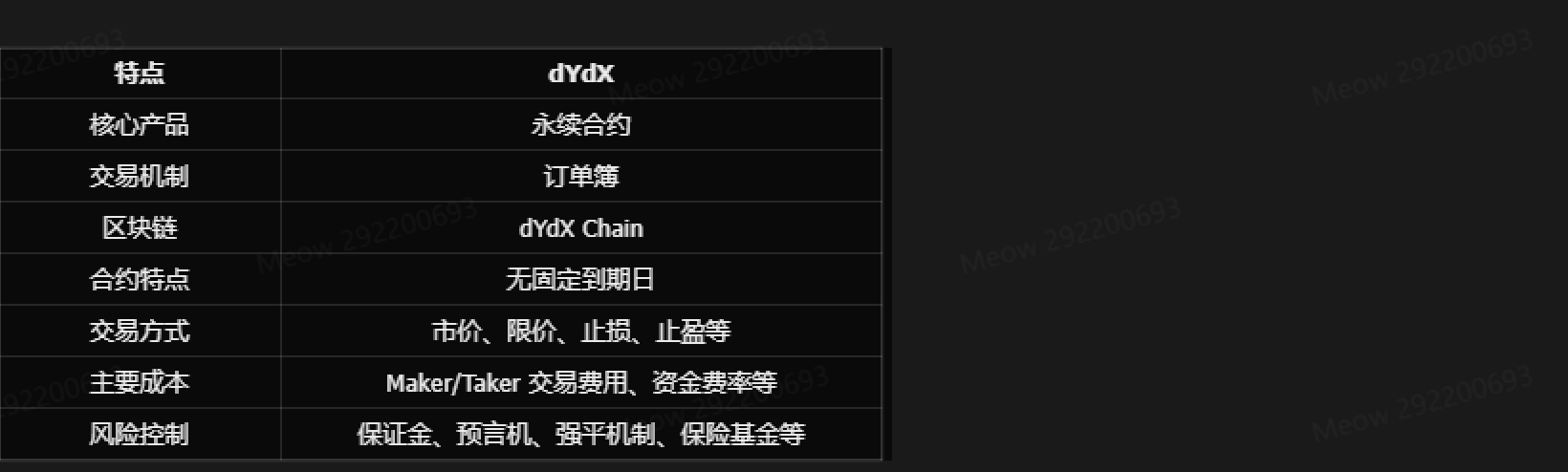
Note that dYdX's products, market parameters and regional availability may change with governance and version upgrades, so the current interface and official rules should be your reference before trading.
Why did dYdX choose an order book instead of an AMM?
The most important thing to understand about dYdX is the difference between the order book model and the AMM model.
Traditional AMM DEXes usually fill trades through liquidity pools. When a user submits a swap request to an ETH/USDC pool, for example, the protocol calculates the execution price from the amounts of the two assets in the pool and its pricing formula.
dYdX instead uses an order book model. Once users submit buy or sell orders, the system matches them according to order price, size and market depth.
This means the two models differ noticeably in trading experience:
- AMMs mainly rely on liquidity pools to provide trading depth;
- An order book shows market orders directly through the bid and ask sides;
- Large AMM trades can cause significant price impact;
- Order book traders can use order types closer to those of professional platforms, such as limit and stop orders.
So for users used to the way traditional exchanges work, dYdX's interface and trading logic are usually easier to understand.
What are dYdX's perpetual contracts?
A perpetual contract is a derivatives contract with no fixed expiry date.
Unlike traditional futures, a perpetual contract does not automatically expire on a set date. Traders can open long or short positions through margin, and unrealized profit or loss follows price movements.
Suppose, for example, that a user uses USDC as margin to open a long position in a BTC perpetual contract:
- If BTC rises, the position shows unrealized profit;
- If BTC falls, the position shows unrealized loss;
- If account equity drops below what risk control requires, liquidation may be triggered;
- If the position is held for a long time, the funding rate also matters.
The key feature of perpetual contracts is that leverage is available, but leverage does not change market direction; it only magnifies profit and loss as well as liquidation risk.
So "higher leverage means higher returns" is not a complete way to judge the situation. A more accurate view is that leverage lowers the initial margin needed to open a larger notional position, while also making the account more sensitive to price swings.
What role does the dYdX funding rate play?
Perpetual contracts have no expiry date, so a mechanism is needed to keep the contract price close to the spot market price over time. That is the important role of the funding rate.
The dYdX Chain funding rate is calculated with reference to factors such as the premium between the perpetual contract market price and the oracle price, and it settles on a fixed cycle. The direction and specific parameters of the funding rate affect the payments between long and short positions.
Put simply:
When the perpetual contract price deviates noticeably from the reference price, the funding rate mechanism can increase the cost or the return of holding a position, creating an incentive for the price to move back.
So when judging the cost of perpetual contract trading, you should not look at trading fees alone. Funding rates, spreads, slippage and potential liquidation costs should be considered together.
What role does the dYdX oracle play?
The oracle is an important part of dYdX's risk management framework.
Because on-chain trading needs external market prices, dYdX Chain uses the Oracle Price in key processes such as collateral valuation, liquidation and some trigger-based orders.
This means the trading price a user sees and the reference price used for risk control are not necessarily identical.
Understanding this matters, because the core risk of perpetual contracts does not come only from "what price did I buy at". It also comes from this chain:
Market price → oracle price → margin ratio → risk assessment → liquidation mechanism
A problem in any one link can affect the outcome of a trade during extreme market conditions.
How does dYdX handle liquidations?
Liquidation is one of the risk mechanisms that leverage traders most need to watch.
When account equity falls below the maintenance margin requirement, the system may trigger liquidation and close the relevant positions to reduce the risk of the account going further into debt.
dYdX Chain's risk parameters include:
- Initial margin ratio;
- Maintenance margin ratio;
- Maximum leverage;
- Open interest caps per market;
- Risk parameters that differ by market.
These parameters are not permanently fixed for every market, and may be adjusted according to governance, market conditions and protocol upgrades.
In extreme conditions, if an account ends up with a seriously negative equity, insurance funds and further risk handling mechanisms may also come into play.
So when trading perpetual contracts on dYdX, it is not enough to assume that "as long as I set a stop loss I will not be liquidated". Extreme volatility, thin liquidity and rapid price jumps can all make actual execution differ from expectations.
Which order types does dYdX support?
dYdX Chain currently supports several order types, including:
- Market Order: executed at prices available in the market;
- Limit Order: sets a maximum buy price or minimum sell price;
- Stop Market: submits a market order once the trigger price is reached;
- Stop Limit: submits a limit order once the trigger price is reached;
- Take Profit Market: executes at market once the target price is reached;
- Take Profit Limit: submits a limit order once the target price is reached.
Different order types solve different problems.
A market order, for example, prioritizes speed of execution but may face spreads and slippage, while a limit order lets you control the execution price without any guarantee of being filled.
For leveraged trading, price control and certainty of execution usually involve a trade-off.
What is the difference between Cross Margin and Isolated Margin on dYdX?
dYdX Chain supports different margin modes, and one important distinction is between cross margin and isolated margin.
In cross margin mode, the available margin in the account can jointly cover the risk of related positions. It makes capital use more flexible, but a large loss on one position can also affect other positions in the account.
Isolated margin mode separates margin from the position risk of a specific market. This limits the maximum risk of a given trade to a relatively independent margin amount.
Put simply:
Cross margin emphasizes capital sharing at the account level; isolated margin emphasizes risk separation between individual positions.
For users new to perpetual contracts, understanding margin modes matters more than focusing only on "how many times leverage can I open".
What are the trading costs on dYdX?
Trading on dYdX involves more than a single fee.
The first is Maker/Taker trading fees. A maker is usually the side that provides liquidity to the order book with a resting order, while a taker actively fills existing orders. The specific rates depend on parameters such as trading volume.
The second is the funding rate. If a perpetual contract position is held for a long period, the funding rate can become a significant cost or source of return.
On top of that, you also need to consider:
- The bid-ask spread;
- Market depth;
- Price impact;
- Market volatility;
- Liquidation-related costs.
By default, dYdX Chain's trading mechanism can reduce part of the gas burden of frequent trading seen in traditional on-chain trading, but that does not mean perpetual contract trading has no cost.
When actually trading, you should check the fee parameters that apply to the current market and account.
How is dYdX different from an ordinary centralized exchange?
The biggest difference between dYdX and a traditional centralized exchange is not "whether there is an order book", but the trading infrastructure and the way assets are controlled.
A centralized exchange usually handles the account system, matching, asset custody and risk control itself. Users deposit assets to the platform and trade through a platform account.
dYdX puts more of the core trading infrastructure into the blockchain network, and users interact with the protocol through a wallet and similar tools.
Each has its own strengths and trade-offs:
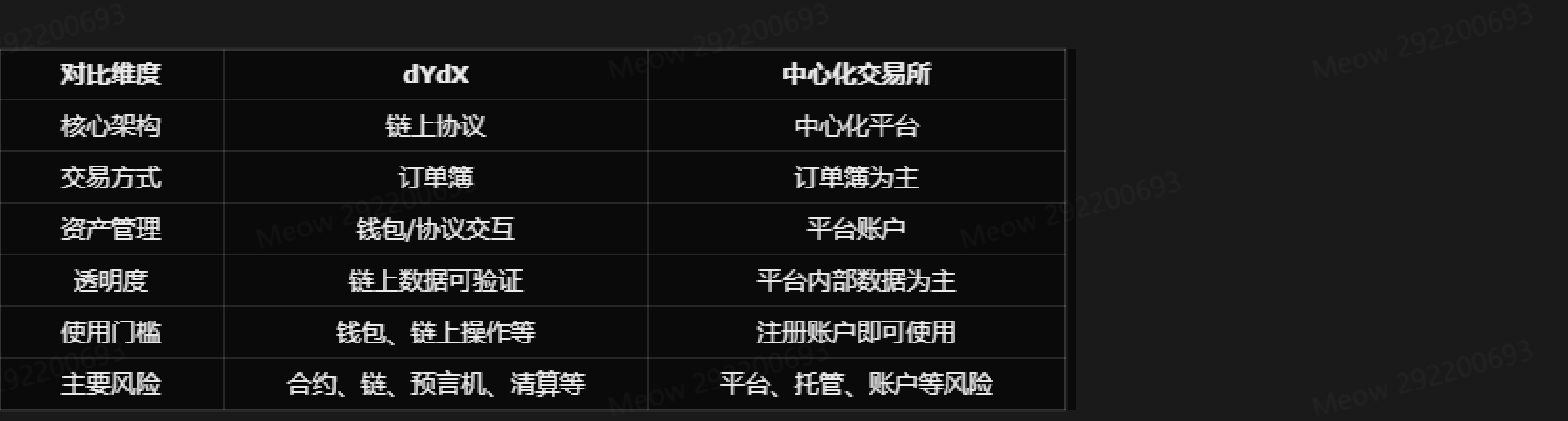
dYdX is therefore not simply "a centralized exchange moved onto a blockchain". It is an attempt to combine professional derivatives trading with decentralized infrastructure.
What should beginners check before using dYdX?
If you are about to try dYdX, it is better not to start with high leverage. Instead, work through the following checks in order:
Step 1: Confirm regional availability. Some countries and regions may be subject to product or service restrictions, especially for derivatives such as perpetual contracts, so confirm first whether the relevant services are allowed where you are.
Step 2: Confirm the connected wallet and network. Do not transfer funds without understanding the network and asset type, and in particular confirm that the deposited asset, the network and the destination address all match.
Step 3: Understand the margin mechanism. First work out what Initial Margin, Maintenance Margin, Cross Margin and Isolated Margin each mean.
Step 4: Check the market parameters. Pay attention to maximum leverage, minimum order size, open interest limits and market depth.
Step 5: Understand the funding rate. If you plan to hold a position for a longer period, include the Funding Rate in your cost calculation.
Step 6: Test with a small position first. Complete a full round of connecting a wallet, depositing, placing an order, cancelling an order and exiting a position before considering a larger trading size.
What type of user is dYdX best suited to?
Judging by its product positioning, dYdX suits users who already understand wallets, blockchain transactions and the basic concepts of perpetual contracts.
If a user only wants simple spot buying and selling, an AMM DEX or a centralized exchange may be easier to start with. If a user wants to trade perpetual contracts through an on-chain order book and is willing to take on the more complex margin, oracle and liquidation risks, then dYdX is worth studying.
It is especially important to remember that "decentralized" does not mean "risk-free".
Users still face multiple risks from smart contracts, the blockchain network, oracles, liquidity, market volatility, leverage and liquidation.
FAQ
Is dYdX a decentralized exchange?
Yes. dYdX is a trading protocol built around decentralized infrastructure, and its core trading activity now runs on its own dYdX Chain. Unlike DEXes that mainly rely on AMM liquidity pools for swaps, it uses an order book trading model at its core.
Can you trade spot on dYdX?
dYdX has long positioned itself around derivatives, especially perpetual contracts. Exactly which products and markets are supported changes with protocol versions and governance, so the markets shown in the current official trading interface should be your reference.
Do dYdX perpetual contracts have an expiry date?
No. Unlike traditional futures, perpetual contracts have no fixed expiry date, but while holding a position you need to watch the funding rate as well as margin and liquidation risk.
Can you use leverage on dYdX?
Yes. Perpetual contracts support leveraged trading, but maximum leverage is not necessarily the same across markets, and risk parameters may change with market open interest and protocol governance. The higher the leverage, the more sensitive the account usually is to price swings, and the higher the liquidation risk.
Do dYdX trades require paying gas?
dYdX Chain's default trading mechanism is designed so that trades themselves do not charge gas fees in the traditional on-chain sense, but users may still incur trading fees, funding rates and other costs related to asset transfers or network operations. The current rules are the final reference.
Conclusion
The core value of dYdX lies in combining order book trading, perpetual contracts and decentralized blockchain infrastructure. Its biggest difference from AMM DEXes is that it does not rely on traditional liquidity pools as the main matching mechanism. Instead, it builds a professional on-chain derivatives trading environment around an order book, matching, margin, oracles and a liquidation system.
For anyone wanting to understand DeFi derivatives, dYdX should not be seen merely as "a DEX where you can trade contracts". It is more useful to understand the trading architecture and risk control mechanisms behind it.
At the same time, perpetual contracts are themselves a high-risk derivative product. Leverage magnifies profit and loss, and funding rates, price volatility, market depth, oracle anomalies and forced liquidation mechanisms can all affect the final trading result. Before using the product, make sure you fully understand its rules and decide carefully whether to participate based on your own risk tolerance.
Inirerekumendang pagbabasa
Tingnan ang higit pa