ETH Dollar-Cost Averaging: The Long-Term Results of Investing Monthly
ETH dollar-cost averaging (DCA) means investing a fixed amount in ETH on a fixed schedule instead of trying to make a single purchase at the market bottom. Its purpose is not to guarantee a profit. It spreads purchases across time, reduces dependence on market timing, and automatically buys more ETH when prices are lower and less when prices are higher. The long-term result ultimately depends on ETH's price, the investment period, the amount invested, the average cost, and trading fees.
What Is ETH Dollar-Cost Averaging?
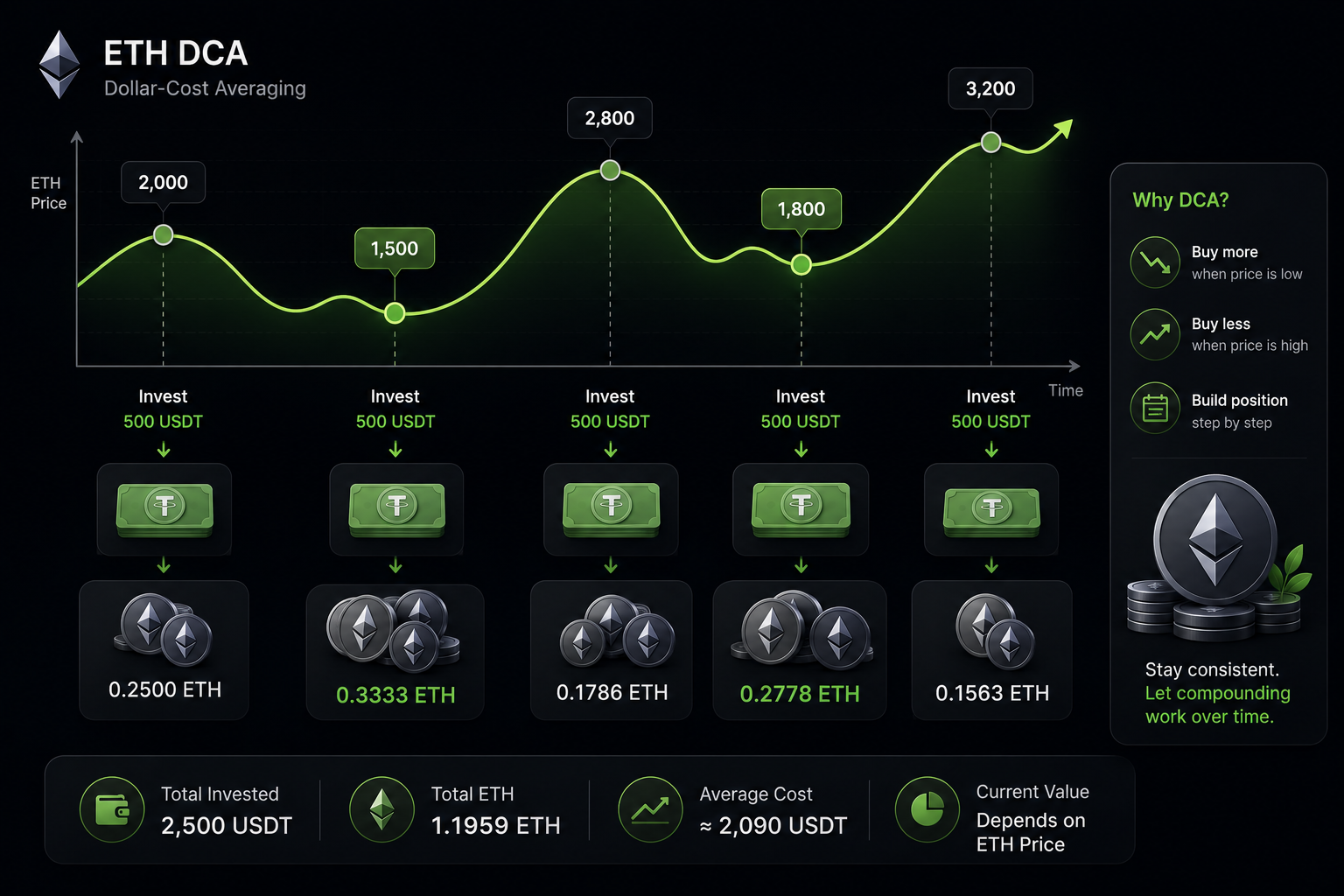
ETH dollar-cost averaging, or ETH DCA, means repeatedly buying ETH according to a predetermined schedule and amount. For example, if you plan to invest 500 USDT each month, you buy 500 USDT worth of ETH every month regardless of whether ETH has risen or fallen.
This differs from a strategy of buying only after a decline.
True DCA follows a fixed rule:
Fixed amount + fixed schedule + consistent execution.
Suppose ETH trades at 2,000, 1,500, and 2,500 USDT over three consecutive months and you invest 500 USDT each month.
The figures here and throughout this article are calculation examples only. They do not represent ETH's current price or Hotcoin's current rules.
The same 500 USDT buys more ETH in the second month after the price falls and less ETH in the third month after the price rises.
That is the basic mechanism of DCA.
How Does ETH DCA Reduce Market-Timing Pressure?
ETH DCA cannot eliminate market risk, but it reduces the need to identify the perfect moment to buy.
A lump-sum purchase asks one difficult question:
"Is this the right time to buy?"
DCA divides that decision into many simpler ones:
"Should I execute this month's planned purchase?"
The two decisions are very different in difficulty.
Suppose you have 12,000 USDT. A lump-sum investment requires you to decide when to convert the entire amount into ETH. A DCA plan can divide it into 12 portions of 1,000 USDT and invest one portion each month.
If ETH rises, falls, and rebounds during those 12 months, you do not need to know in advance which day will be the bottom.
There is, however, an important limitation: DCA is not automatic bottom-fishing.
If ETH continues to decline over the long term, a DCA position can still lose money. If ETH rises continuously throughout the investment period, investing more at the beginning may produce a higher final return.
DCA therefore reduces dependence on market timing; it does not guarantee returns.
How Are ETH DCA Returns Calculated?
You cannot calculate a DCA result simply as:
Amount invested × ETH price increase
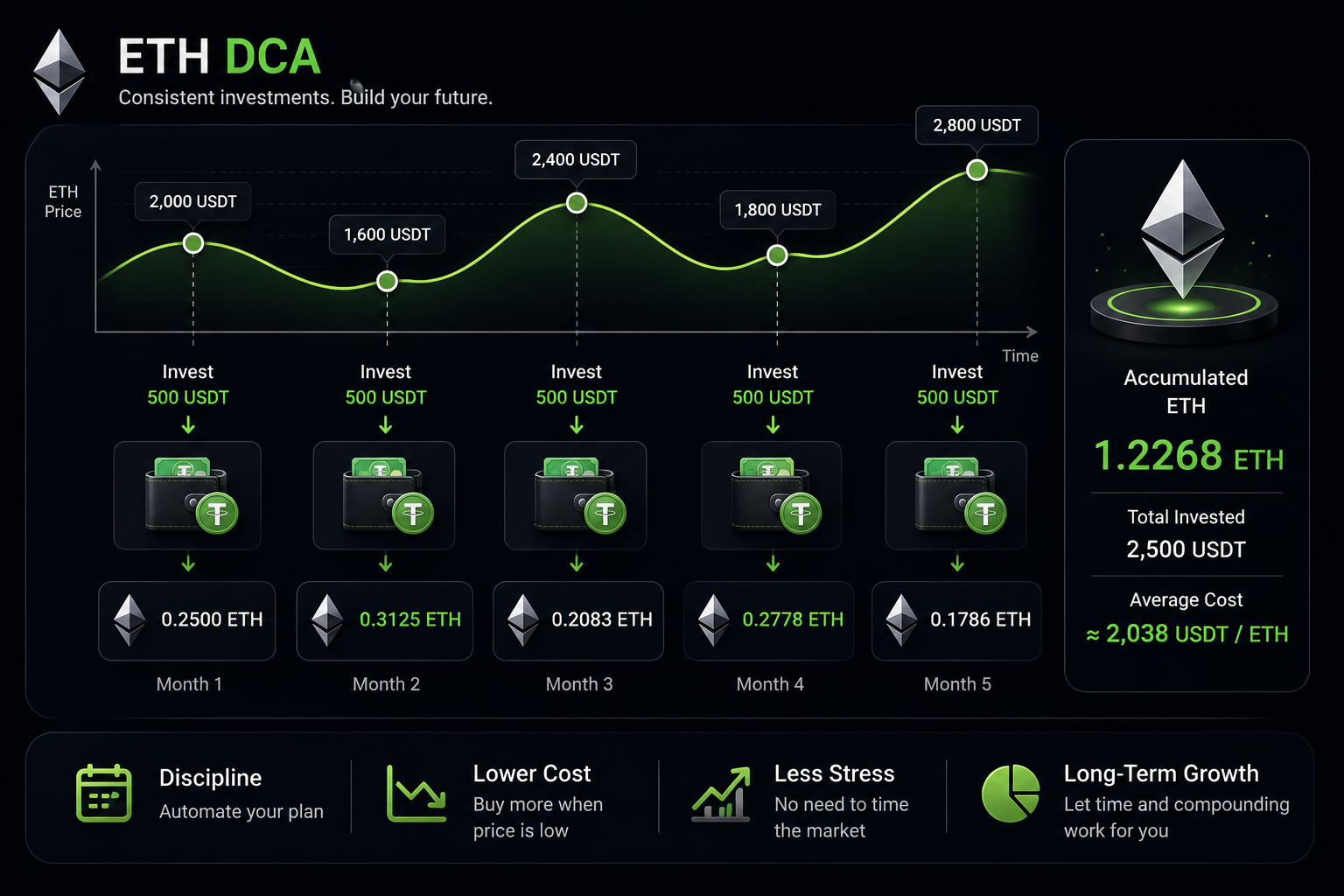
You bought ETH in installments at different prices, so a more accurate calculation is:
Total ETH accumulated = amount of each purchase ÷ ETH purchase price at that time
Average cost = total amount invested ÷ total ETH accumulated
Current position value = total ETH accumulated × current ETH price
Unrealized profit or loss = current position value − total amount invested
Return = unrealized profit or loss ÷ total amount invested × 100%
For example, suppose you invest 1,000 USDT per month for four months. These are illustrative figures, not ETH's current price.
Total invested:
4,000 USDT
Total ETH:
0.5000 + 0.4000 + 0.6250 + 0.5000
= 2.025 ETH
Average cost:
4,000 ÷ 2.025
≈ 1,975.31 USDT/ETH
If ETH later rises to 2,500 USDT, the position value is:
2.025 × 2,500
= 5,062.50 USDT
Example profit:
5,062.50 − 4,000
= 1,062.50 USDT
Example return:
1,062.50 ÷ 4,000 × 100%
≈ 26.56%
The important point is not the final 26.56%, but how purchases at different prices created the average cost.
Why Does DCA Buy More ETH When the Price Falls?
A fixed-amount plan naturally buys more units when the price is lower. The same funds can buy more ETH as its price falls.
For example, with a fixed 500 USDT purchase:
ETH = 5,000 USDT → buy 0.1 ETH
ETH = 2,500 USDT → buy 0.2 ETH
ETH = 1,000 USDT → buy 0.5 ETH
A falling market therefore increases the amount of ETH accumulated per purchase.
This does not mean that a decline is always beneficial. If the decline is temporary and the price later recovers, the ETH bought at lower prices can reduce the overall average cost. If ETH enters a prolonged downtrend, the position value may keep falling even though each installment buys more ETH.
Therefore:
Buying more at a lower price ≠ guaranteed profit.
DCA ultimately depends on the price recovering above your long-term average cost by enough to cover trading and other costs.
Is Monthly ETH DCA Better Than a Lump-Sum Purchase?
There is no universal answer.
If you already have cash set aside for a long-term ETH investment, the main difference is how quickly that capital enters the market.
A lump-sum purchase puts the capital into the market earlier. It will usually be more favorable if ETH subsequently rises continuously.
DCA puts the capital into the market in installments. It can reduce the risk of investing the entire amount near a high if the price later fluctuates sharply or falls.
Another frequently overlooked issue is whether the money is already available. Investing a fixed amount from each monthly paycheck is not equivalent to holding a lump sum in cash and deliberately spreading it over 12 months.
The first approach invests future cash flow as it arrives. The second delays the deployment of money that is already available beyond living expenses and emergency reserves.
How Much Should You Invest in ETH Each Month?
There is no fixed amount suitable for everyone.
A better approach is to determine how much you can sustainably invest over the long term before choosing the installment amount.
Investable cash flow = stable income − living expenses − necessary savings − emergency-fund needs
You can then decide what share of that investable cash flow may be allocated to a highly volatile asset.
The key question is not, "How can I invest as much as possible each month?" It is, "Can I keep following this plan even if ETH falls for several months?"
The hardest part of DCA is often not making the first purchase, but continuing to follow the original plan during a declining market.
Should You Invest in ETH Monthly or Weekly?
Both monthly and weekly plans can work for long-term ETH accumulation. The important considerations are execution cost and how often your income becomes available.
Monthly DCA:
Requires fewer transactions;
Is easier to manage;
Suits people with fixed monthly income;
Produces fewer trades.
Weekly DCA:
Spreads entry times more widely;
Distributes exposure to short-term volatility more evenly;
Requires more frequent execution;
Requires separate consideration of trading costs.
If each transaction incurs a fee, trading more frequently does not necessarily improve the final result.
For example, Plan A invests 1,000 USDT once per month, while Plan B invests 250 USDT each week. Both commit the same amount, but Plan B executes more trades. Those additional costs must be included in the long-term return calculation.
It is therefore inaccurate to assume that weekly DCA is always better than monthly DCA.
Income stability + execution habits + trading costs + price volatility together determine which frequency is more suitable.
How Long Should an ETH DCA Plan Last?
If you use DCA, define the investment period in advance instead of deciding each month based on recent gains or losses.
Possible plan lengths include:
6 months
12 months
24 months
36 months
Each period carries different price risks. For a volatile asset such as ETH, "long term" does not mean that the price must rise. ETH has experienced major bull and bear cycles, so holding longer may increase the chance of passing through a full market cycle, but it cannot eliminate the asset's price risk.
A more practical plan defines three conditions in advance.
Start condition: When does the plan begin?
Execution condition: On what date and for what amount will each purchase occur?
End or adjustment condition: Under what circumstances will you stop, reduce, increase, or reassess the plan?
This prevents DCA from turning into chasing rallies and stopping after declines.
Should You Continue DCA When ETH Falls?
If the basis of your plan has not changed, stopping solely because ETH fell is inconsistent with the original fixed-schedule strategy.
Continuing, however, is not an unconditional recommendation. During a sharp decline, reassess whether your budget remains appropriate, whether your cash flow has changed, whether the money has a more important use, whether your risk tolerance has changed, and whether you are still willing to accept a further decline.
If those answers change, you can adjust the plan.
The real danger is interpreting "stay consistent" as "keep buying no matter what." DCA is a capital-management method, not a mechanical obligation.
What Is the Biggest Advantage of ETH DCA?
Its greatest advantage is not automatically buying low and selling high. It is reducing the number of discretionary decisions.
A lump-sum buyer may repeatedly ask whether the market has bottomed, whether it can fall further, and when to buy. DCA converts much of that forecasting into execution:
Scheduled date → execute the planned purchase.
This can reduce two common emotional traps.
The first is FOMO: after ETH rises quickly, fear of missing out causes an investor to increase the amount abruptly.
The second is panic: after ETH falls quickly, fear of further losses causes an investor to stop the original plan.
DCA cannot prevent losses, but it can reduce frequent plan changes driven by short-term emotion.
What Is the Biggest Disadvantage of ETH DCA?
If ETH rises throughout the investment period, buying in installments may underperform investing the entire amount at the beginning. Part of the capital remains unexposed while it waits for later purchase dates.
Consider a simple example. These figures are illustrative and do not represent current prices or future performance.
Suppose you have 12,000 USDT.
Plan A invests the full amount in ETH on the first day.
Plan B invests 1,000 USDT per month for 12 consecutive months.
If ETH rises continuously over those 12 months, Plan A gains price exposure earlier and may finish ahead of Plan B. If ETH falls sharply soon after the first purchase, Plan B can make later purchases at lower prices.
DCA is therefore not necessarily a higher-return strategy. It is a method for reducing the impact of a single entry point and improving investment discipline.
How Do You Build an Executable ETH DCA Plan?
A simple ETH DCA plan can be divided into five parameters.
First, amount: How much USDT will you invest each time?
Second, frequency: Weekly, every two weeks, or monthly?
Third, duration: Six months, 12 months, or longer?
Fourth, asset allocation: What share of your investable portfolio will ETH represent?
Fifth, adjustment rules: Under what conditions will you reassess the installment amount?
For example:
Invest 1,000 USDT per month
Execute on the first trading day of each month
Run the plan for 12 months
Do not change the amount because of short-term price moves
Review cash flow and risk tolerance quarterly
This is more actionable than simply saying, "I believe in ETH for the long term, so I will buy a little each month."
How Should You Evaluate ETH DCA Returns?
Do not look only at the amount of profit. At a minimum, track four figures:
Total amount invested
Total ETH held
Average cost
Current position value
For example, suppose you have invested 12,000 USDT and accumulated 4 ETH. Your average cost is:
12,000 ÷ 4
= 3,000 USDT/ETH
If ETH is now 3,500 USDT, the position value is:
4 × 3,500
= 14,000 USDT
Unrealized profit:
14,000 − 12,000
= 2,000 USDT
Return:
2,000 ÷ 12,000
≈ 16.67%
If ETH instead falls to 2,500 USDT, the position value becomes 10,000 USDT, the unrealized loss is 2,000 USDT, and the return is −16.67%.
DCA is not a calculator that guarantees a positive return. It helps establish an average cost, while the final outcome still depends on ETH's future price.
Do ETH DCA Plans Need to Account for Fees?
Yes.
When each purchase incurs a trading fee, repeated transactions reduce the actual return.
Actual total cost = total purchase amount + total trading fees
For example, suppose a plan executes 12 purchases of 500 USDT in one year. The nominal investment is:
500 × 12 = 6,000 USDT
If each transaction costs 1 USDT, annual trading fees are:
1 × 12 = 12 USDT
These figures are examples and do not represent Hotcoin's current fee rate. The investment cost calculation cannot consider only the nominal 6,000 USDT. Fixed fees can have a particularly noticeable impact when each installment is small.
When designing a plan, ask not only, "How much will I buy each month?" but also, "What is the actual cost of each trade?"
What Is the Difference Between ETH DCA and Buying the Dip?
The two strategies are often confused, but they are not the same.
DCA invests according to a fixed rule regardless of whether the price rises or falls.
Buying the dip increases investment only after the price meets a decline threshold.
For example, investing 500 USDT every month is DCA. Investing 800 USDT after ETH falls 10% and 1,200 USDT after it falls 20% is buying the dip.
The latter requires a definition of what qualifies as a sufficient decline and therefore demands more market judgment.
Without explicit rules, buying the dip can turn into emotional behavior: chasing after a rally because of fear of missing out, then refusing to buy after a decline because of fear that it will continue.
Trading rules should be set before volatility occurs, not improvised after prices begin moving sharply.
When Is ETH DCA Unsuitable?
DCA is not appropriate in every situation. Exercise caution if:
You will need the money in the short term;
Your cash flow is highly unstable;
You cannot tolerate large ETH price swings;
You are allocating all available funds to ETH;
You expect a guaranteed return within a few months;
You cannot accept a significant unrealized loss.
ETH is a highly volatile crypto asset. Long-term DCA does not mean you cannot lose money in the short term. If you cannot accept a substantial temporary loss, reassess the amount rather than simply extending the plan.
What Problem Should ETH DCA Actually Solve?
Many people frame ETH DCA as, "How can I make money by buying ETH every month?" That framing is incomplete.
The real problem DCA addresses is, "If I cannot reliably predict ETH's short-term price, how can I establish a disciplined long-term purchase plan?"
Its main benefits are reducing the importance of a single entry point, reducing frequent market timing, and defining the investment rules in advance.
It cannot determine whether ETH will rise, how far it may rise, how large a drawdown the investment period may include, or whether a better allocation opportunity will appear.
That distinction is essential when deciding whether DCA suits you.
ETH DCA FAQ
Can Monthly ETH DCA Really Make Money?
There is no guarantee. DCA spreads purchases across time and reduces dependence on one entry point, but the result still depends on ETH's future price. If ETH is below your average cost at the end of the investment period, the position may still have a loss.
How Much ETH Should I Buy Each Month?
There is no universal amount. Choose an amount that does not interfere with daily expenses, emergency savings, or other necessary spending, and that does not force you to stop because of financial pressure if ETH continues to fall.
Is Weekly or Monthly ETH DCA Better?
Neither is always better. Weekly DCA spreads entry times further but creates more transactions. Monthly DCA is simpler and often matches monthly cash flow. Actual trading fees must also be considered.
Should I Continue DCA If ETH Keeps Falling?
If your original plan, cash flow, and risk tolerance have not changed, you may continue according to the existing rules. If your financial circumstances or tolerance have changed, reassess the plan instead of investing mechanically for the sake of consistency.
Does ETH DCA or a Lump-Sum Purchase Produce Higher Returns?
It cannot be known in advance. A lump-sum purchase may perform better if ETH rises throughout the investment period. DCA may benefit from lower later purchase prices if the market falls substantially after the first investment. The actual price path determines the outcome.
Does ETH DCA Require Long-Term Holding?
DCA usually works best with a clearly defined investment period; otherwise, short-term volatility can cause frequent plan changes. Long term, however, does not mean the price must rise and does not remove ETH's market risk.
Risk Warning
ETH is a highly volatile crypto asset. DCA cannot guarantee a profit or prevent loss of principal.
Historical price performance does not guarantee future results. Even a long-running plan can experience major gains, losses, or an extended market downturn.
Do not let the phrase "long-term DCA" obscure asset allocation, liquidity needs, or risk tolerance. The installment amount should come from funds you can sustainably invest, not borrowed money or money required for basic living expenses.
All calculations in this article explain the DCA mechanism only. They do not represent ETH's current price, future returns, or Hotcoin's current trading rules.
If You Want to Start Buying ETH
If you have never bought ETH, begin with the complete purchase process:
How to Buy Ethereum (ETH): 2025 Complete Guide
If You Are Preparing for Your First BTC Purchase on Hotcoin
Continue with:
Inirerekumendang pagbabasa
Tingnan ang higit pa