How to Evaluate the Security and Trustworthiness of a Crypto Exchange
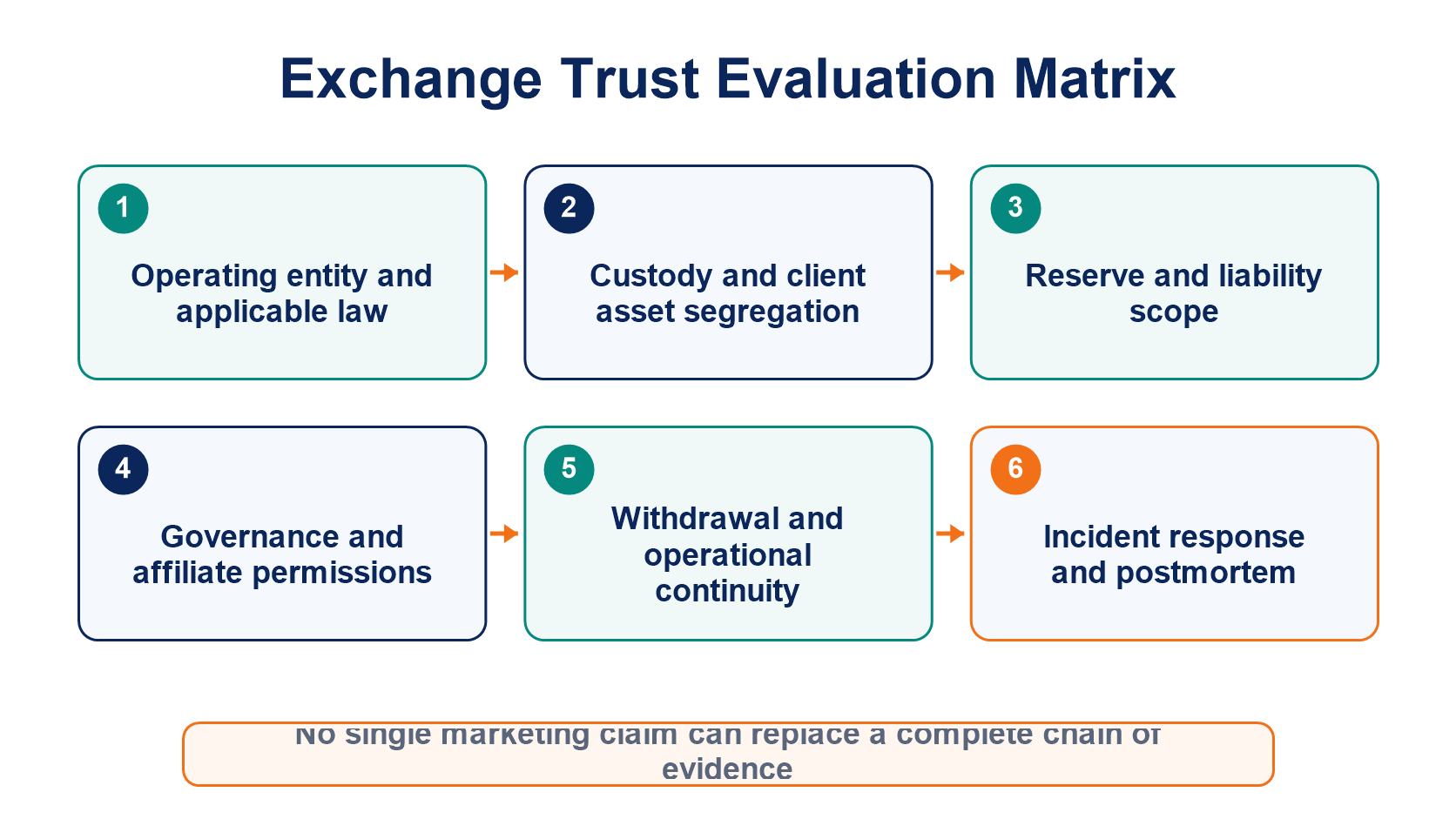
Evaluating an exchange means examining who operates it, who safeguards the assets, what the platform owns, what it owes users, who can move funds, and whether users can reliably withdraw. No single ranking can replace this body of evidence.
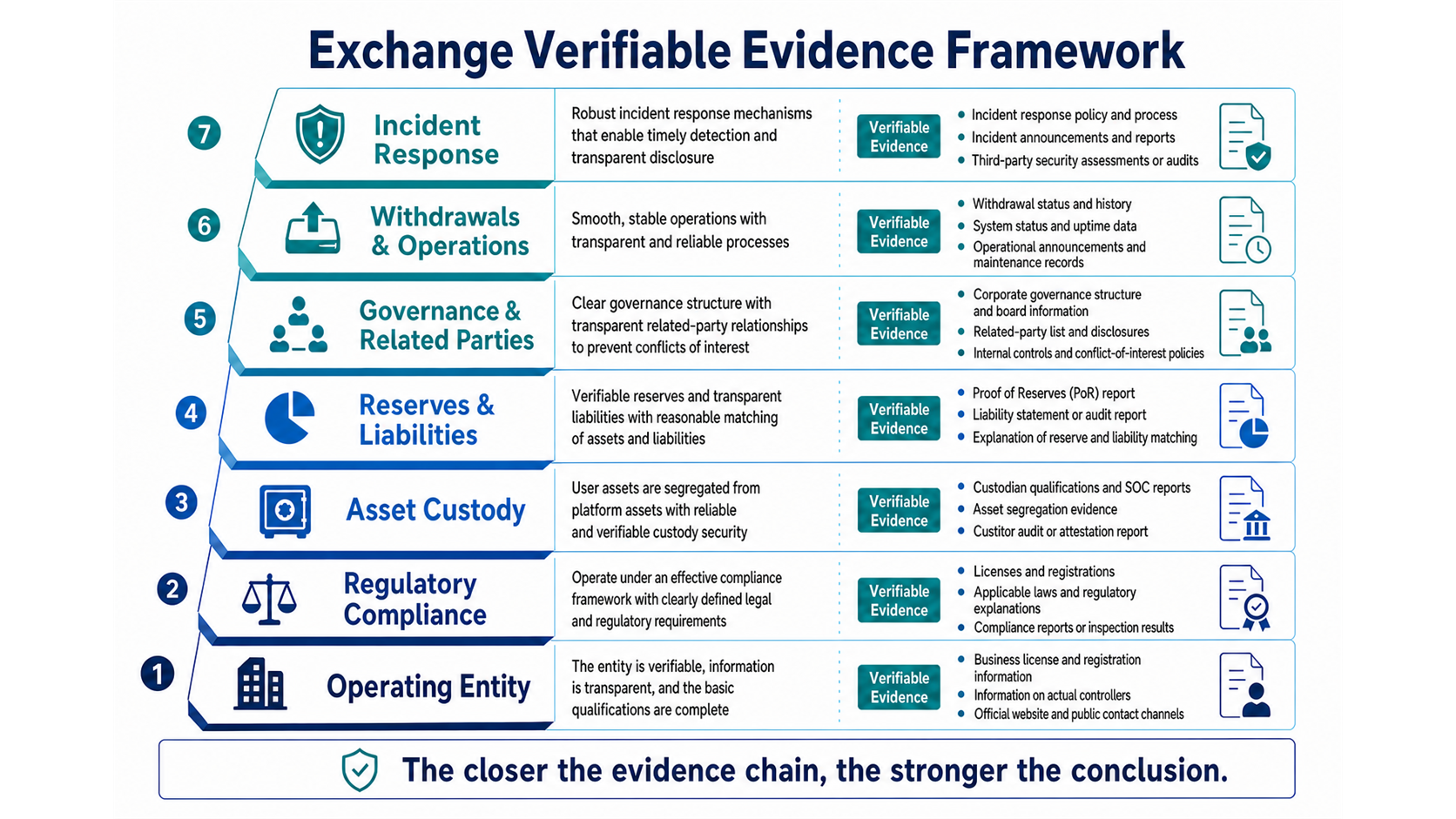
Step 1: Identify the Operator You Are Actually Dealing With
The same brand may use different regional entities to provide spot trading, derivatives, custody, and fiat services. Check the terms of service for the contracting entity, place of registration, governing law, dispute-resolution process, and regions where each product is available.
Being “registered” does not mean every business activity is covered by the same regulation. Verify which entity holds each license, what activities it covers, and whether your account belongs to that entity. Confirm website logos and license screenshots against the regulator’s own database.
Step 2: Separate Custody From Control
Determine whether customer assets are held directly by the platform, by a third-party custodian, or through a combination of both. Find out where hot wallets, cold wallets, MPC, and multisignature controls are used. Technical labels alone do not prove safety; approval thresholds, separation of duties, and emergency privileges also matter.
Customer balances appear in an internal database, while on-chain wallets are controlled by the platform or its custodian. Users need to know whether assets are segregated, whether they may be lent, staked, or pledged as collateral, and what rights customers might have if the company becomes insolvent.
Step 3: Examine Reserves and Liabilities Together
A proof-of-reserves report should address control of assets, customer liabilities, inclusion of user balances, and the reporting date. Publishing wallet addresses alone does not show whether those assets secure other debts, nor does it reveal fiat obligations, borrowing, or related-party liabilities.
When reading a report, note which assets it covers, the snapshot time, verification method, scope of third-party work, and whether users can verify their own balances. Proof of reserves is one layer of evidence, not a complete financial audit or a guarantee of future solvency.
Step 4: Review Governance and Related-Party Risk
Check whether board, management, risk, finance, and custody responsibilities are separated. An affiliated market maker, lender, fund, or exchange token can create conflicts of interest, so the platform should disclose limits, collateral rules, and related-party transaction policies.
The FTX case showed that a sophisticated trading interface and prominent risk messaging cannot substitute for segregation of customer assets, restrictions on related parties, and genuine internal controls. Look for systems that constrain managers rather than relying on personal assurances.
Step 5: Test Withdrawal and Operational Capability
Use a small amount to test deposits, trading, and withdrawals, then compare on-chain timing, fees, status-page updates, and customer-support responses. Such a test may expose operational friction, but it cannot prove the platform would have sufficient liquidity during a run.
Review past withdrawal suspensions, maintenance notices, and incident reports. Distinguish maintenance on a single blockchain, account-level risk controls, and platform-wide liquidity problems. Prolonged, vague restrictions without a formal appeal process are a serious warning sign.
Step 6: Check User-Side Security Controls
Prefer platforms that support passkeys or hardware security keys, TOTP, session management, least-privilege API access, IP allowlists, withdrawal allowlists, and security waiting periods. Changes to security settings should trigger renewed verification and a separate notification.
For a more technical methodology, read Crypto Exchange Security Ratings. Related guides cover Proof of Reserves, Custody Models, Exchange Risk Controls, Insurance and User Protection Funds, Lessons From FTX, Historical Exchange Failures, and Layered Asset Storage.
Frequently Asked Questions
Is an older exchange necessarily safer?
Operating history is one piece of evidence, but it cannot replace an assessment of the current legal entity, assets, permissions, and financial position. Even a long-established platform can undergo governance or technical changes.
Does a smooth app experience indicate strong security?
It reflects only part of the platform’s product capability. A polished interface cannot prove the adequacy of reserves, liabilities, customer-asset segregation, or controls over management privileges.
Are numerous user reviews reliable?
Reviews may be affected by selection bias or manipulation. Compare them with verifiable reports, regulatory records, on-chain data, and official incident timelines.
Can I keep all my assets on one platform after it passes the assessment?
No assessment can eliminate the risk of a single-platform failure. Layer your asset storage according to your trading needs, ability to self-custody, and tolerance for a worst-case loss.
Inirerekumendang pagbabasa
Tingnan ang higit pa