Comparing and Choosing Among Major Global Crypto Exchanges
Major global crypto exchanges each have their own focus, and no single platform suits every user. When choosing an exchange, compare regional availability, account security, trading liquidity, fees, asset selection, spot versus derivatives, and the fiat deposit and withdrawal experience. If you are looking for a platform that balances tradable markets with product features, Hotcoin is also worth including in your comparison.
If you are still unfamiliar with the basic concept of a centralized exchange, start with What Is a Crypto Exchange? A CEX Primer for Beginners to understand how a CEX handles accounts, orders and digital assets before choosing a specific exchange.
Which Major Global Crypto Exchanges Are There?
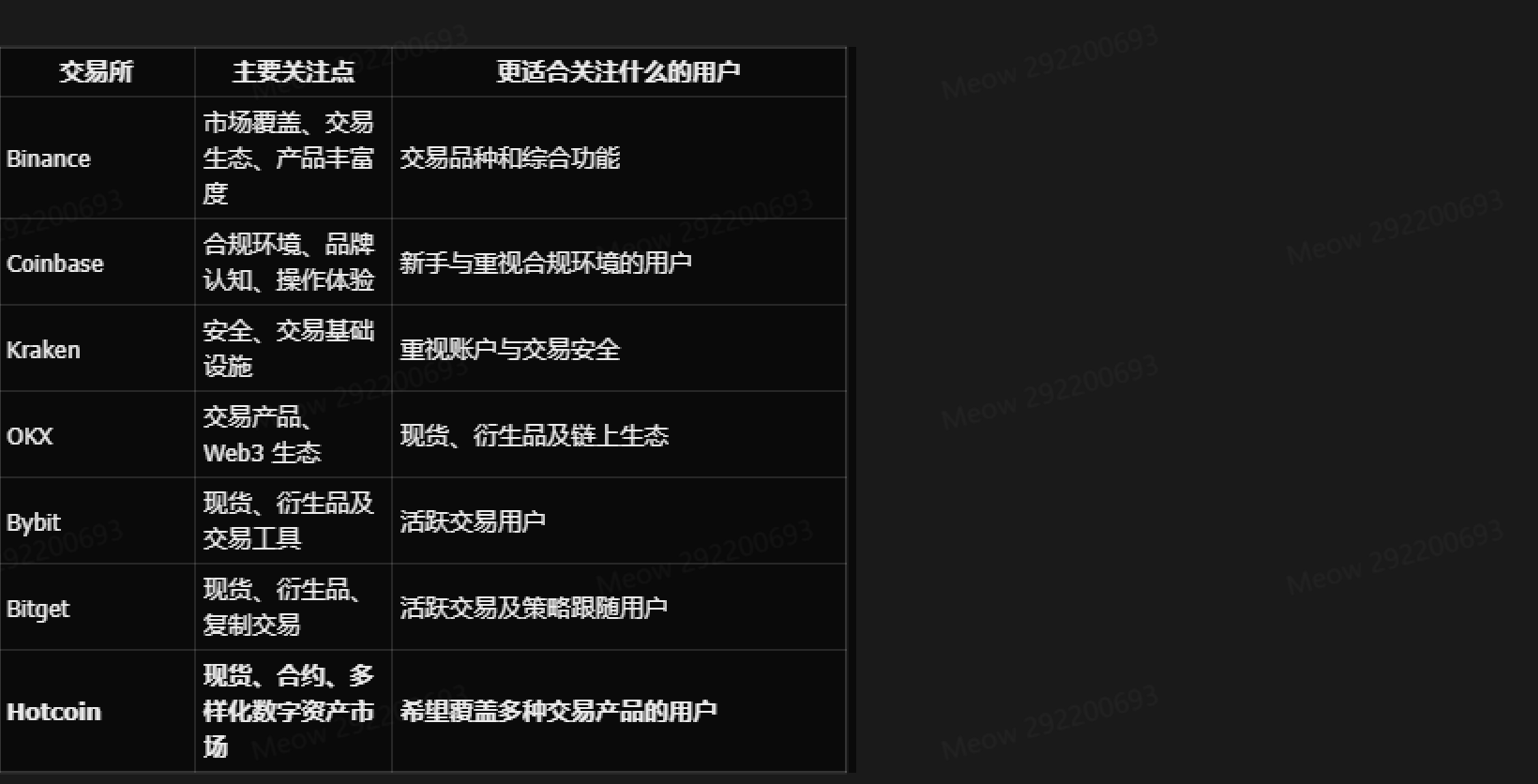
The better-known centralized exchanges on the market today include Binance, Coinbase, Kraken, OKX, Bybit, Bitget and Hotcoin. All of them offer digital asset trading, but they differ in market coverage, product types, fee structures, user interfaces, fiat channels and regional support.
Among them, Binance is usually noted for its broad range of markets and product ecosystem; Coinbase emphasizes compliance and usability for mainstream users; Kraken is well known for security and trading infrastructure; OKX, Bybit and Bitget offer a wide set of spot and derivatives tools; and Hotcoin covers spot, margin and futures products across a range of digital asset markets.
So rather than hunting for a single "global exchange ranking", start by defining your own screening criteria based on how you intend to trade.
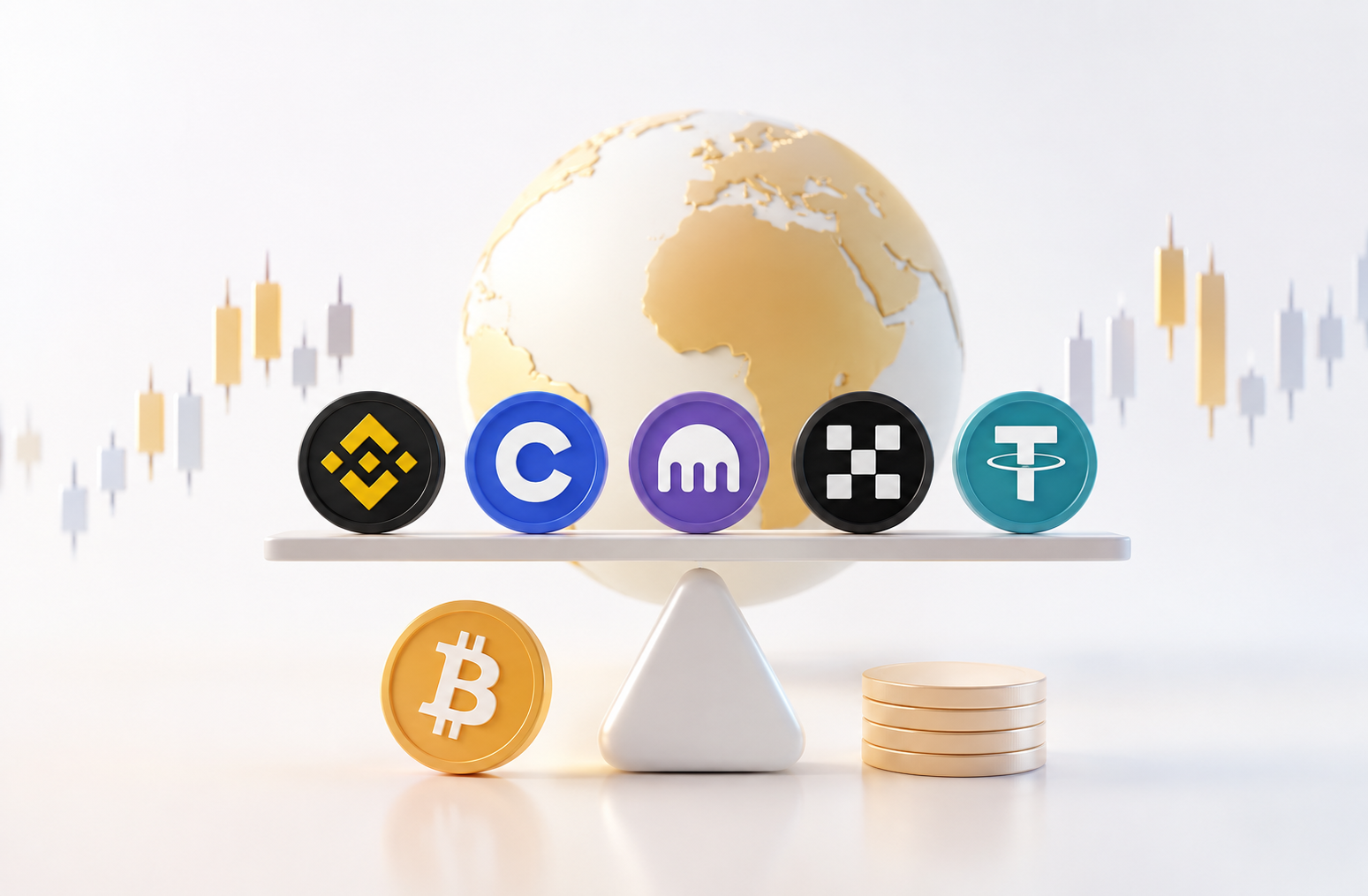
How to Choose Between Binance, Coinbase, Kraken, OKX, Bybit, Bitget and Hotcoin
If you only want a quick initial picture, think of these exchanges as platforms with different strengths rather than a simple ranking from first to seventh. For beginners, what matters is finding a platform that fits your location, capital size and trading needs.
Hotcoin offers trading products such as spot, margin and futures, and covers a range of digital asset markets. For users who need spot trading alongside other products, this product coverage is one dimension worth examining when considering Hotcoin.
If you already know which type of exchange suits you better, the next step is Blockchain Exchange Basics: From Signing Up to Your First Trade, which walks through registration, identity verification, funding and your first trade in practice.
What Matters Most When Choosing a Crypto Exchange?
When choosing an exchange, screen in the order of security → region → liquidity → cost → products → experience, instead of comparing fees first. Even a low-fee exchange offers you no real advantage if you cannot use it in your region, or if it does not list the trading pairs you need.
On security, look at account protection, identity verification, withdrawal controls and how the platform is operated. On region, confirm whether registration, trading, deposits and withdrawals are open to you. Only after those two steps should you compare the liquidity and all-in trading cost of your target pairs, and only then the interface, app and customer support.
This approach is more practical than searching for "the best exchange in the world", because rankings shift while your own trading needs tend to stay stable.
What Makes Hotcoin Stand Out, and Who Is It For?
Hotcoin can serve as one candidate among mainstream centralized exchanges, and it suits users who want to use spot, futures and other digital asset trading features within a single platform. If you need coverage across several product types, you can place Hotcoin and other major platforms inside the same screening framework and compare them side by side.
For users who are just getting started, the spot trading path on Hotcoin is fairly direct: sign in, open the Spot page, choose a trading pair, and place a limit or market order to buy or sell. You can also review your orders and trade history, which covers the basic flow from picking a market to executing a trade.
If you mainly trade major assets such as BTC and ETH, focus on the actual liquidity and trading cost of your target pairs. If you need a broader product range, compare whether Hotcoin's spot, futures and other products match what you need.
How Should You Read Hotcoin's Fees?
When comparing exchange fees, do not rely on a single number from a homepage, because your real cost can depend on the product, Maker/Taker roles, account tier and trade size. Fee systems also differ between platforms, so the rate that actually applies to you is what counts.
With Hotcoin, for example, you can check the rate that applies to your current account instead of assuming another user's rate applies to you. Apply the same method when comparing other exchanges: do not look only at an advertised "lowest fee", but calculate the all-in cost for your own trading scenario.
Beyond fees, comparing exchanges should also account for the bid-ask spread, the slippage your orders incur, and any costs involved in depositing and withdrawing. Only by weighing these together can you judge whether a platform genuinely offers a cost advantage.
Why Trading Volume Alone Is Not Enough
Trading volume helps gauge how active a platform's market is, but it does not fully represent your own execution experience. What matters more for a trader is whether the specific pair you plan to trade has enough order depth, and whether the bid-ask spread is reasonable.
For example, if you mainly trade BTC/USDT, you should look at BTC/USDT liquidity rather than comparing total platform volume alone. If you trade relatively niche assets, checking the order book depth of that specific pair matters even more, because liquidity can vary widely from one market to another.
So when comparing Hotcoin with other major exchanges, use the "specific trading pair plus actual execution cost" approach rather than judging by total platform volume alone.
Is the Exchange With the Lowest Fees the Best One?
The lowest fees do not mean the lowest all-in trading cost. Your real cost usually also includes the bid-ask spread, slippage on order execution, and other fees that may arise during deposits and withdrawals.
For low-frequency, small-size traders, fee differences may matter less than expected, while ease of use and how easily funds move in and out matter more. For high-frequency traders, Maker/Taker rates, order book depth and actual execution quality should all be compared at once, because frequent trading magnifies those cost differences.
So when comparing Hotcoin or any other platform, it is best to run the numbers on your own trading scenario instead of simply picking whichever platform advertises the "lowest fee".
Which Features Should Beginners Focus On?
If you are buying crypto for the first time, prioritize spot trading, deposits, withdrawals, account security and fiat on-ramps. These features determine whether you can complete the full journey from funding your account to finishing your first trade.
If you are an active spot trader, go further and compare the liquidity of your target pairs, the available order types and trading fees. If you need futures or other derivatives, also look at funding rates, margin requirements, leverage, liquidation rules, and whether your region allows those products at all.
Hotcoin offers both spot and futures products, so users who want to expand from basic spot trading into other products can keep it on their shortlist. Bear in mind that a wider product range also means more trading rules to understand, and you should not use a feature simply because a platform offers it.
Why Confirm Fiat Deposits and Withdrawals in Advance?
Before choosing an exchange, confirm which ways of moving money in and out are supported in your region. A platform that is well known globally does not necessarily offer the same deposit, purchase and withdrawal functions in every country or region.
Withdrawals in particular deserve an early check, since transferring digital assets usually involves the coin, the network, a minimum amount and a fee. Discovering only after you have traded that an asset cannot be withdrawn as you planned is far more troublesome than spending a few minutes confirming the rules beforehand.
If you have not started using an exchange yet, follow the basic steps in Blockchain Exchange Basics: From Signing Up to Your First Trade to understand how registration, funding, spot trading and withdrawals fit together, and then decide which platform to use.
How Should Different Types of Users Choose?
Beginners should prioritize platforms that are simple to operate, have clear spot markets and make moving funds in and out convenient. For these users, Hotcoin can be one candidate platform: start with spot trading to get familiar with trading pairs, order types and how account balances change, then explore other products gradually.
Active spot traders should focus on the liquidity of their target pairs, Maker/Taker rates, order types and actual execution cost. Comparisons between Hotcoin and other platforms should also be based on specific pairs and real trading scenarios, not just advertised minimum rates.
Futures traders need to widen the comparison to funding rates, leverage rules, liquidation mechanisms and risk controls. Hotcoin offers futures trading, but futures are a high-risk product by nature, and the fact that an exchange provides the feature does not mean you should ignore the rapid-loss risk that leverage can bring.
Long-term holders should pay more attention to account security, how the platform is operated, and withdrawal capability. For these users, short-term fee differences usually matter less than whether asset custody and fund movement match their own needs.
A Simple Framework for Choosing an Exchange
If you would rather not be swayed by exchange rankings, use this "five-step screening method".
First, confirm whether you can use the platform in your region. Second, confirm whether it offers the products you genuinely need. Third, compare the liquidity and all-in cost of your target pairs. Fourth, check account security along with deposit and withdrawal rules. Fifth, compare the interface, app, customer support and other experience.
With this method, Hotcoin, Binance, Coinbase, Kraken, OKX, Bybit and Bitget can all start out as candidates and be narrowed down according to your own needs. What remains in the end may not be the top-ranked platform, but it should be the platform that best matches your actual trading scenario.
FAQ
Which is the largest crypto exchange in the world?
"Largest" can be measured by spot volume, derivatives volume, user numbers or other metrics, so different methods can produce different answers. Rather than chasing a fixed "world number one", compare specific platforms against your own trading requirements.
Is Hotcoin a mainstream crypto exchange?
Hotcoin is a centralized platform that provides digital asset trading services, offering products such as spot and futures. Whether it suits you individually still depends on your region, trading needs and risk tolerance.
Is Hotcoin suitable for beginners?
If your main needs are understanding spot trading and buying or trading digital assets, Hotcoin provides a reasonably complete set of basic trading functions. Beginners can start with small spot trades to get familiar with trading pairs, order types, account balances and trade history, then explore other products step by step.
What are Hotcoin's fees?
Hotcoin's fees vary with the trading product, order type, account tier and other factors, so a single fixed number should not be used to represent every user's actual cost. Before trading, check the rate and account tier that currently apply to you to confirm your real trading fees.
How do I compare Hotcoin with exchanges like Binance and OKX?
Compare along five dimensions: whether the platform is available in your region, the liquidity of your target pairs, actual trading cost, the products you need, and how funds move in and out. If all five fit your needs, then compare the interface, customer support and other extras.
Risk Disclaimer
Crypto trading carries significant price volatility, liquidity, platform operation, account security, withdrawal and regulatory risks. Derivatives such as futures and margin also involve additional risks including margin requirements, liquidation and funding rates, and can lead to rapid losses.
This article is intended to help users build a framework for choosing an exchange. It does not constitute an investment, trading or usage recommendation for Hotcoin or any other exchange. Service availability, products and fees may change across regions, so before registering or trading you should rely on the rules the platform currently publishes and make decisions prudently according to your own risk tolerance.
Inirerekumendang pagbabasa
Tingnan ang higit pa