
Staking/Yield Calculator
A staking/yield calculator quickly estimates the expected return, annualized yield and maturity value of a staking or yield product. Enter the principal, the annualized rate and the term, and you get the result instantly, so you can judge the potential return before you commit.
Staking and on-chain yield products are a common way to earn passive income on crypto. A yield calculator automates the compounding and period maths, so you can see the potential return clearly before joining. The guide below covers how to use these tools efficiently in practice.
Tool page: https://www.hotcoin.com/tools/staking-calculator/
What can a staking/yield calculator work out?
Most calculators support the following core features:
Expected total return: calculates the return at maturity from the principal, annualized rate and term.
Annualized yield (APY/APR): distinguishes simple from compound interest.
Total value at maturity: shows the final amount of principal plus return.
Daily/monthly income estimate: makes short-term cash flow easier to see.
Compounding comparison: shows the difference between compound and simple interest.
Multiple periods: calculates by day, week, month or year as needed.
Some tools also let you enter different lock-up terms or enable auto-compounding.
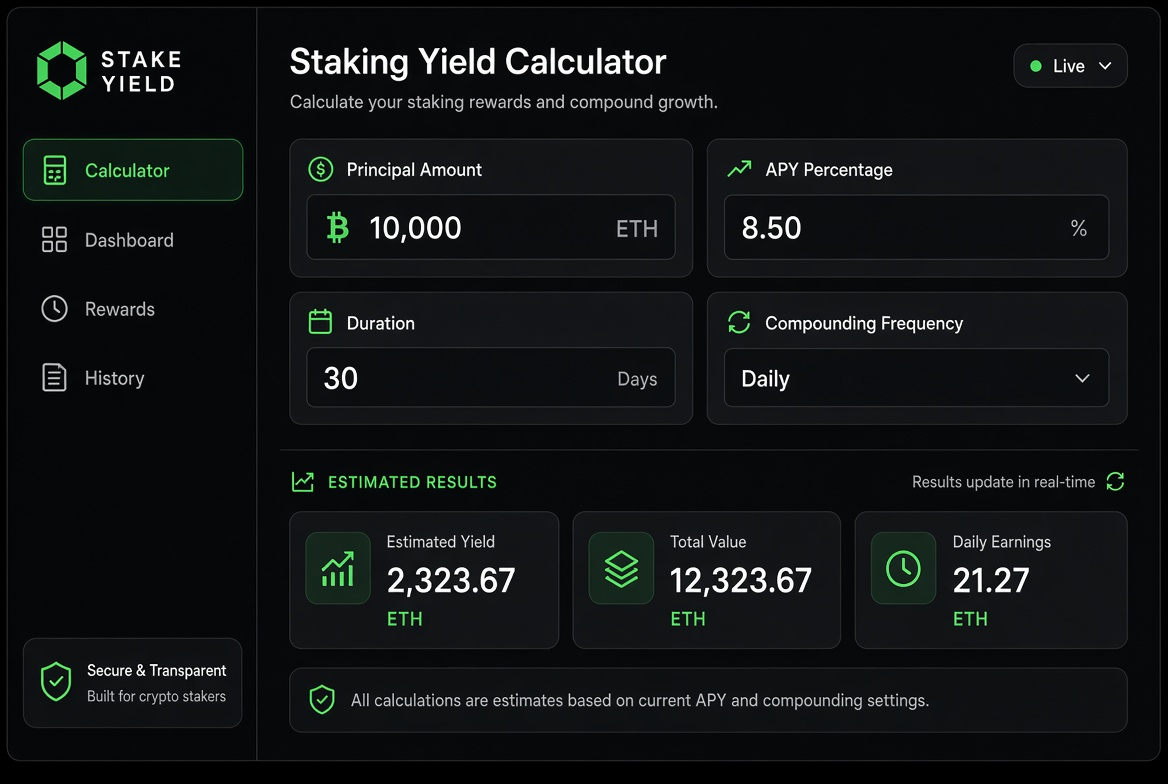
How to use a staking/yield calculator (step by step)
Open the yield calculator offered by an exchange or DeFi platform, or use a dedicated third-party tool.
Enter the principal (USDT, ETH, BTC and other common assets are supported).
Fill in the annualized rate (APY or APR, whichever the platform displays).
Choose the investment term (days, months or years).
Choose whether to enable compounding (auto-reinvest).
Run the calculation and review the expected total return, maturity value and daily earnings.
Change the parameters and compare runs (different terms or different APYs, for example) to pick the best option.
The process is straightforward, and far more efficient and accurate than working it out by hand — a practical gain that few top-ranking pages explain systematically.
How to read the results correctly
APY vs APR: APY normally already includes compounding, while APR is a simple annual rate. The two are not interchangeable.
Compounding effect: the longer the term and the more frequent the reinvestment, the bigger the compounding advantage.
What you actually receive: calculator output is usually theoretical and must be reduced by platform fees, lock-up penalties or early-redemption losses.
Yield volatility: APYs on some flexible yield products or liquidity mining change in real time, so results are indicative only.
Common caveats:
A high APY usually comes with higher risk (smart contract risk, lock-up risk, impermanent loss and so on).
Early redemption of a locked product may cost you part of the return or the principal.
The calculation does not include changes in asset value caused by price movements.
Use cases and risk warning
Pre-entry assessment: compare expected returns across platforms or terms.
Compounding planning: understand how long-term reinvestment affects the final return.
Cash flow estimation: work out roughly how much you can earn per day or per month.
Risk warning: staking and yield products carry the risk of losing your principal, including smart contract exploits, platform risk and market volatility. Calculator output is a theoretical estimate only and is not a guarantee of return or investment advice. Read the project rules carefully and only use funds you can afford to lose.
FAQ
Q1: What is the difference between APY and APR?
A: APR is a simple annual rate, while APY is the annualized rate after compounding. For the same headline number, APY delivers the higher actual return.
Q2: Is the return shown by the calculator guaranteed?
A: No. Most figures are theoretical estimates, and the actual return can differ because of APY changes, fees, early redemption or project risk.
Q3: How is compounding calculated?
A: The return is normally added to the principal at the set reinvestment frequency (daily, weekly and so on), and later periods are then calculated on the larger balance.
Q4: Why does my actual return differ from the calculator result?
A: Possible reasons include real-time APY adjustments, platform fees, lock-up rules, or price movements in the asset itself.
Q5: What should beginners focus on when using a yield calculator?
A: Focus on principal safety and lock-up conditions first, and the level of APY second. Higher yields usually mean higher risk.
Inirerekumendang pagbabasa
Tingnan ang higit pa