
Yield Farming Tutorial: From Adding Liquidity to Calculating Returns
Yield farming is a common return strategy in DeFi. At its core, you deposit tokens into a liquidity pool, provide capital for trading, lending and similar activity, and earn from trading fees, lending interest or protocol incentives. It looks like simply “putting assets in and earning a yield”, but the real return must also deduct impermanent loss, gas, price volatility and smart contract risk, so you cannot judge a pool by the APY shown on the page alone.
What Is Yield Farming?
Yield farming can be understood simply as: users provide idle crypto assets for DeFi protocols to use, and earn a corresponding return based on the liquidity they supply.
Take the AMM liquidity pool of a decentralized exchange. Traders need to swap tokens against the pool, while liquidity providers (LPs) supply the assets the pool holds. Every time a trade happens, the protocol usually charges a fee under its own rules, and part of that fee is used to reward liquidity providers.
Beyond trading fees, some protocols also distribute governance tokens or other incentive tokens. This combination of “fee income + token incentives” is the basis of many yield farming strategies.
Note that providing liquidity and yield farming are not exactly the same concept.
Providing liquidity answers the question “does the pool have enough capital for trading?”; yield farming puts more emphasis on how to earn by providing liquidity, staking LP tokens, or taking part in other DeFi mechanisms.
Where Do Yield Farming Returns Come From?
To judge whether a farming pool is worth joining, the first step is not to look at the APY, but to work out where the return is actually generated.
1. Trading Fees
This is the most direct source of income for an AMM liquidity pool.
When users swap tokens in the pool, they pay a trading fee. Where the protocol rules allow, liquidity providers receive a share of it.
In Uniswap’s classic AMM model, for example, trading fees are added to the liquidity pool and ultimately show up in the value of the LP position. Fee mechanisms differ between versions and between pools, so a fixed fee rate from one pool cannot be applied to every pool.
As a result, a pool with a modest APY but steady trading volume may produce healthier real returns than a pool with a very high APY and almost no genuine trading activity.
2. Protocol Incentives
Many yield farming projects distribute extra tokens to LPs on top of trading fees.
For example:
Provide ETH/USDC liquidity → receive LP shares → claim additional project tokens
Provide ETH/USDC liquidity → receive LP shares → claim additional project tokens
Such incentives can attract liquidity quickly in a project’s early stage, but they come with an obvious problem:
The reward token itself may keep losing value.
So a page showing 50% APY, 100% APY or even more does not mean your assets will definitely grow by that proportion.
3. Lending Interest
DeFi yield strategies are not limited to DEXs.
In lending protocols, users can supply assets to a pool and borrowers pay interest on them. With Aave, for example, after you supply assets your balance grows dynamically according to the current supply rate, which is affected by factors such as capital utilization.
So in a broader sense, yield farming can also include strategies that combine lending, staking, liquidity provision and protocol incentives.
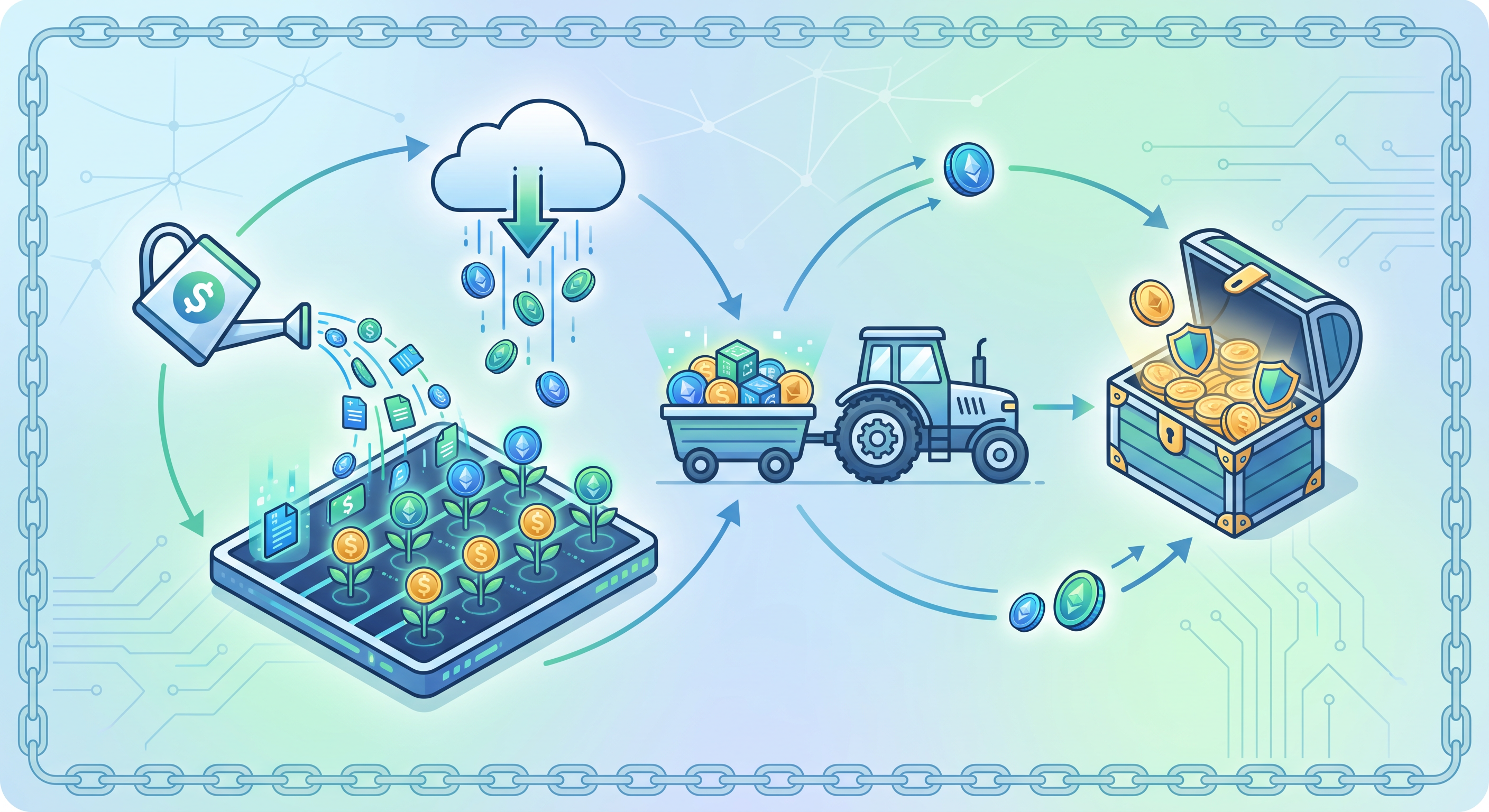
How Does Yield Farming Actually Work?
A typical DEX farming flow can be simplified as:
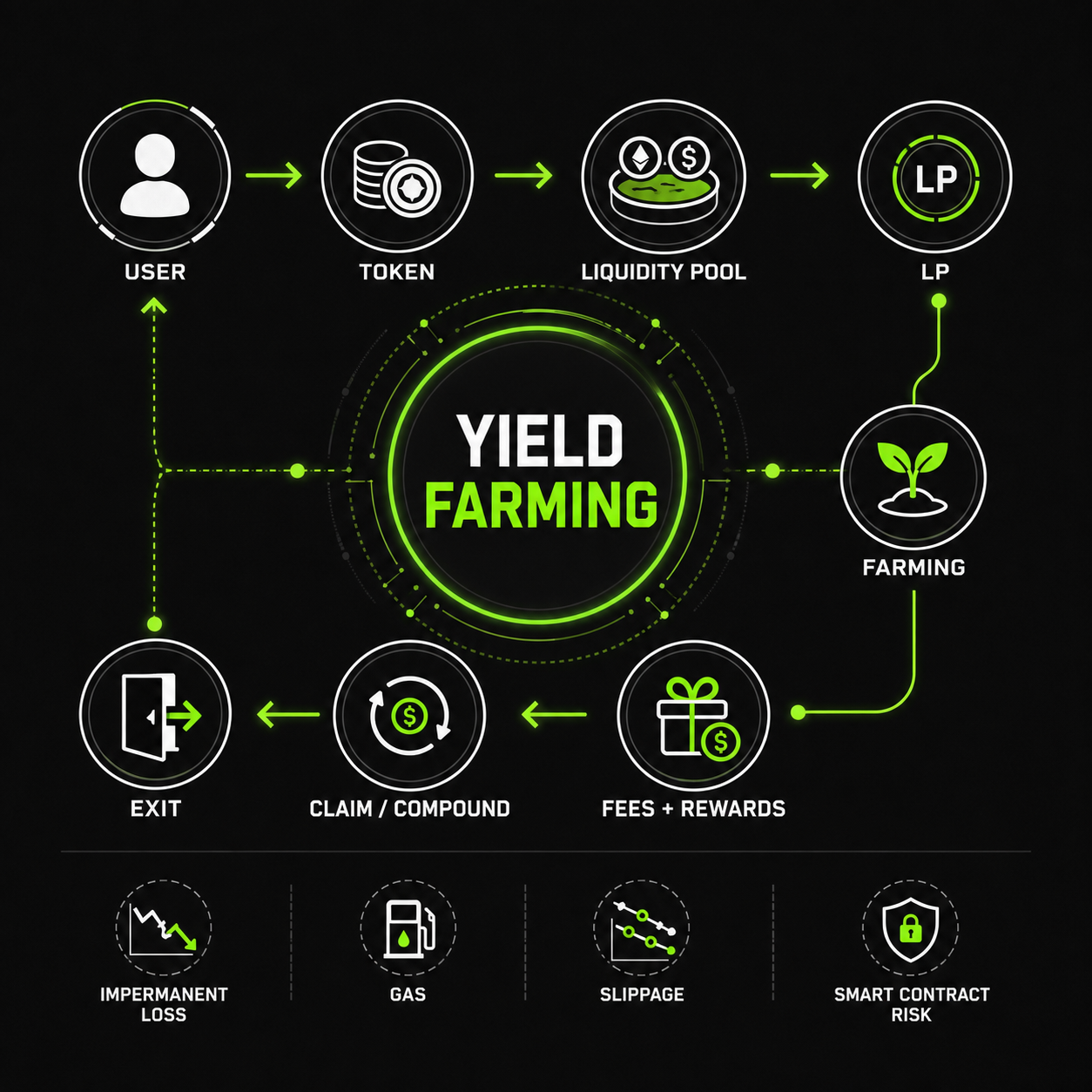
User assets → add liquidity → receive LP shares → join farming → earn fees/incentives → claim or compound rewards → remove liquidity
Suppose you plan to join an ETH/USDC liquidity pool.
You usually need to:
Prepare ETH and USDC;
Enter the relevant DeFi protocol;
Select the ETH/USDC liquidity pool;
Deposit both assets as the protocol requires;
Receive the corresponding LP position;
If farming incentives exist, deposit the LP position into the farming contract;
Keep earning fees or extra tokens;
Decide whether to claim, compound or exit based on market conditions.
In practice, each step may involve an on-chain transaction, so gas costs must be factored in alongside the expected return.
Yield Farming in Practice: How Do You Choose a Pool?
Do not deposit money the moment you see a high APY.
Check the following indicators one by one.
Step 1: Confirm the Underlying Assets
Start with what the pool actually holds.
For example:
USDC/USDT
ETH/USDC
ETH/a small-cap token
Two highly volatile tokens
Different asset combinations carry completely different risks.
Stablecoin pairs usually fluctuate relatively little, but they still carry depeg, smart contract and protocol risk; pools of volatile assets may expose you to both token price swings and impermanent loss.
Step 2: Look at TVL and Real Trading Volume
TVL helps show how much liquidity a pool currently holds, but a large TVL does not mean the return is necessarily high.
What matters more is whether:
the pool has genuine trading activity;
trading volume is stable;
liquidity size matches trading volume;
the return comes mainly from fees or from token subsidies.
If a pool has a very large TVL but very low trading volume, the return from trading fees alone may not be attractive.
Step 3: Break Down the APY
When you see “APY 30%”, do not read it as “assets grow 30% in a year”.
Keep asking:
Where does that 30% come from?
Suppose a hypothetical farming pool shows:
Trading fee income: 8%
Project token incentives: 22%
The headline APY is 30%, but 22% of it depends on the price of the reward token and how it is distributed.
If the reward token keeps falling in price, the real return may be clearly lower than the figure on the page.
Step 4: Check Contract and Protocol Risk
DeFi returns rest on smart contracts running normally.
So at a minimum, check whether:
the project publishes its contracts;
the contracts have been professionally audited;
the contracts have undergone major upgrades;
admin permissions exist;
pause, upgrade or fund-control permissions exist;
the team’s tokens are highly concentrated;
the protocol has a long operating history verified by real capital.
Even an audited protocol should not be treated as “absolutely safe”. Aave’s own risk disclosure also makes clear that smart contracts and blockchains are continuously evolving technology, and users may still face the risk of asset loss.
How Do You Calculate the Real Return on Yield Farming?
Do not count only the farming rewards.
A more practical approach is:
Real return ≈ fee income + farming rewards − impermanent loss − gas − other trading costs
The most easily overlooked item is impermanent loss.
Suppose you provide liquidity worth 10,000 USDC to an ETH/USDC pool.
After some time:
Fee income: +500 USDC
Farming reward value: +300 USDC
Gas and trading costs: −100 USDC
Impermanent loss: −400 USDC
You cannot simply conclude that you made 800 USDC.
Under these assumptions:
500 + 300 − 100 − 400 = 300 USDC
So the “yield” on a page and the assets your wallet actually gains can differ noticeably.
The numbers here only illustrate the calculation method; they are not the actual return of any specific pool.
Why Is Impermanent Loss One of the Biggest Yield Farming Risks?
Once you put two assets into an AMM liquidity pool, if the price ratio between them changes substantially, the AMM adjusts the quantities of assets in the pool to maintain its pricing mechanism.
This means:
The amounts of the two tokens you eventually withdraw may differ from simply holding them.
Say you provide ETH/USDC liquidity.
If ETH rises sharply after you provide liquidity, arbitrage trades keep adjusting the ratio of ETH to USDC in the pool, so the pool ends up with relatively less ETH and relatively more USDC.
The result is:
You earned fees, but your portfolio may miss part of the gain from ETH’s rise.
This is the impermanent loss often discussed in yield farming.
To learn how impermanent loss is calculated, how price changes affect LP assets, and how to reduce the related risk, read on:
What Is Impermanent Loss? Calculation and Mitigation Strategies
How Can Beginners Reduce Yield Farming Risk?
If you are new to yield farming, it is not advisable to chase a high APY from the start.
A simpler screening framework works better:
Assets → pool → sources of return → costs → risks → exit
Assets
First confirm whether you are willing to hold both tokens in the pool for the long term.
If you do not even understand the underlying tokens, you should not provide liquidity just because the APY is high.
The Pool
Focus on:
TVL;
trading volume;
liquidity depth;
how long the pool has been running;
whether there are obvious abnormal capital movements.
Sources of Return
Break the return apart:
fee income + token incentives + other income
instead of looking at a single APY.
Costs
Calculate:
gas;
token approval costs;
the cost of adding liquidity;
farming operation costs;
the cost of claiming rewards;
the cost of removing liquidity.
For users with smaller capital, if operating costs take too large a share of the expected return, frequent compounding may actually lower the final result.
Risks
Consider at least:
token price risk + impermanent loss + smart contract risk + liquidity risk + declining incentive risk
Exit
Before you enter, you should already decide:
Under what conditions will you exit?
For example:
APY falls sharply;
incentive tokens keep losing value;
TVL drops quickly;
trading volume clearly shrinks;
the protocol suffers a security incident;
the fundamentals of the underlying assets change.
Do not wait until serious problems appear before thinking about exiting.
Frequent Actions: Does Compounding Really Earn More?
Many farming strategies promote “auto-compounding” or “compound interest”.
In theory, if returns can be reinvested and keep generating returns, compounding may indeed raise long-term results.
In practice, however, you need to consider:
compounding return > compounding cost
If every claim costs gas while each reward is only a small amount, claiming and compounding frequently may actually reduce net returns.
So compounding frequency should be based on:
reward size;
gas;
expected yield;
asset volatility;
changes in protocol incentives
rather than mechanically compounding every day.
The 5 Most Common Yield Farming Mistakes
1. Looking Only at the APY
A high APY often comes with higher asset, protocol or incentive risk.
2. Ignoring the Reward Token Price
If rewards are paid mainly in the project’s own token, price changes in that token directly affect your real return.
3. Ignoring Impermanent Loss
Fees and farming rewards may not cover the loss caused by asset price changes.
4. Ignoring Gas and Slippage
When small amounts are traded frequently, on-chain costs can swallow a considerable share of the return.
5. Having No Exit Plan in Advance
A genuinely mature farming strategy studies not only “how to get in” but also “how to get out” ahead of time.
Who Is Yield Farming Suitable For?
Yield farming suits users who already understand:
wallets and on-chain transactions;
AMM;
LP;
APY/APR;
impermanent loss;
gas;
smart contract risk.
If you have just entered DeFi, start with low-complexity strategies and gradually understand the relationship between asset prices, liquidity and returns, rather than going straight into high-incentive, highly volatile pools.
Be especially wary of claims such as “guaranteed profit”, “capital-protected high yield” or “double your money short term”. Ethereum’s official security guidance also warns users about high-yield crypto investment scams promoted through social media and similar channels.
FAQ
What is the difference between yield farming and staking?
Staking mainly means locking or delegating tokens to take part in a blockchain network’s consensus and earn rewards; yield farming usually means providing liquidity to DeFi protocols and earning from trading fees, lending interest or protocol incentives. The two differ in both income sources and risk structure.
Are liquidity pools with higher APY always more worth joining?
Not necessarily. The APY may include a large share of short-term token incentives and does not reflect impermanent loss, asset price volatility, gas or smart contract risk. Break down the sources of return before judging a pool.
Does yield farming always create impermanent loss?
As long as the price relationship between assets in the pool changes, impermanent loss relative to simply holding the assets is possible. How large it is depends on the price change, the pool mechanism and the price at the time you exit.
Are stablecoin pools risk-free?
No. Although stablecoins usually fluctuate less against each other, they can still face depeg, smart contract, protocol, liquidity and issuer risks, so stablecoin farming should not be treated as risk-free income.
Should I look at APR or APY for yield farming returns?
APR usually means the simple annualized rate without compounding; APY usually includes compounding. Both are only yield metrics and neither alone represents your final real return.
Summary
The point of yield farming is not “finding the highest APY”, but finding a liquidity strategy with clear sources of return, understandable risks, manageable costs, and a fit with your own holding logic.
When calculating returns properly, consider fees, protocol incentives, token price changes, impermanent loss, gas and exit costs together. For beginners especially, rather than chasing short-term high yields, it is better to first understand LP, AMM, impermanent loss and protocol risk, and then gradually increase strategy complexity.
Risk warning: DeFi, yield farming and crypto assets carry relatively high risk. Historical returns, the APR/APY shown on a page, or protocol incentives do not represent future returns. Users may lose part or even all of their principal because of token price volatility, impermanent loss, smart contract vulnerabilities, protocol attacks or insufficient liquidity. Before participating, make sure you fully understand the relevant mechanisms and make an independent judgement based on your own risk tolerance.
Inirerekumendang pagbabasa
Tingnan ang higit pa