DeFi Security: Common Attack Methods and Prevention Guide
DeFi security risk comes mainly from smart contract vulnerabilities, oracle manipulation, flash loan attacks, malicious approvals, phishing sites and loss of control over permissions. Unlike traditional finance, an on-chain transaction is usually very hard to reverse once it is confirmed. That is why security is not only about whether a project has been audited, but about whether risk exists in five areas: code, data, permissions, transactions and user behaviour.
Why Is DeFi Such an Easy Target?
DeFi protocols usually manage assets automatically through smart contracts, so trading, lending, staking, swapping and liquidation all follow preset rules. This automation removes intermediaries, but it also means a flaw in the code can turn directly into lost assets.
More importantly, DeFi is not an isolated smart contract. A lending protocol may depend on DEX prices, oracles, stablecoins, cross-chain bridges and other protocols. If one link breaks, the risk can spread along the composability relationships between protocols.
So when judging how safe a DeFi project is, "has it been audited?" is not enough. Keep asking: who supplies the price? Who holds admin permissions? What has the user approved? Where do the key assets come from? Can the system be paused when something goes wrong?

1. Smart Contract Vulnerabilities: Code Executes Mistakes Precisely
The defining feature of a smart contract is automatic execution. If the contract logic has a flaw, an attacker does not need to control a server. Finding a transaction path that satisfies the flaw may be enough to make the contract move assets according to the wrong logic.
Reentrancy Attacks
Reentrancy is one of the classic smart contract vulnerabilities. In simple terms, the contract calls an external contract before finishing its own state update, and a malicious contract can use that window to call the original function again.
For example, a flawed withdrawal function may send funds to the user first and update the user balance afterwards. If the attacker calls the withdrawal function again immediately after receiving the assets, and the balance has not been updated yet, the same funds can be withdrawn repeatedly.
Modern Solidity development reduces this risk through compiler checks, the checks-effects-interactions pattern and reentrancy locks, but that does not mean every contract is automatically safe.
Broken Access Control
Another high-risk category comes from permission configuration. An admin may be able to change critical parameters, upgrade the contract, change asset addresses or pause the system. If that power sits in a single address without multisig or timelock limits, a leaked admin key can turn straight into lost assets.
So when you look at a DeFi project, do not only ask whether the contract code has bugs. Also look at:
What can the admin change?
Who holds upgrade permissions?
Is a multisig used?
Is there a timelock on critical operations?
Is there an emergency pause mechanism?
Have permissions been renounced, or does some address still control them?
An audit report only shows what was found at the time of the audit. It cannot prove that nothing will ever go wrong in the future.
2. Oracle Manipulation: A Wrong Price Becomes an Attack Tool
DeFi protocols often need to know the price of BTC, ETH, stablecoins or other assets, but a smart contract cannot read off-chain market data directly, so it relies on an oracle to supply prices.
The problem is that if a protocol depends too heavily on a single price source, an attacker can manipulate the price and affect critical logic such as lending, liquidation and collateral ratios.
A typical attack path looks like this:
The attacker borrows a large amount of capital → creates an abnormal price in a thin market → the oracle reads the abnormal price → the lending protocol values collateral at the wrong price → the attacker receives funds they should never have received.
This is why "what is the current DEX price" and "what price should the protocol use" are not the same question. The instant price of a single pool can be moved by a large trade, while a more robust design usually relies on multiple data sources, decentralised oracles or time-weighted prices.
So when you assess a DeFi protocol, check where its price data comes from and whether a single price source is involved.
3. Flash Loan Attacks: The Problem Is Amplification, Not Borrowing
A flash loan lets a user borrow a large amount of assets within a single transaction, as long as it is repaid before the transaction ends.
A flash loan is not an attack in itself. The real issue is that it gives an attacker enormous temporary capital without requiring long-term holdings, which amplifies flaws in protocol design.
A typical attack can form a chain like this:
Obtain a large amount of capital through a flash loan → manipulate the market price → trigger flawed protocol logic → acquire mispriced assets → repay the flash loan → keep the profit.
So when you see "flash loan attack", do not read it simply as "a flash loan caused the theft". A more accurate reading is this: the flash loan supplied the leverage, while the actual vulnerability usually sits in the price oracle, collateral calculation, liquidation mechanism or other protocol logic.
4. Malicious Token Approval: You May Transfer Nothing and Still Hand Over Permission
Many DeFi operations do not transfer tokens to a contract directly. Instead, you first approve a contract to use your tokens.
For example, if you want to swap USDT on a DEX, the wallet may ask you to approve the relevant contract to use USDT. Once approved, that contract can call the asset within the approved limit.
The genuinely dangerous part is a malicious approval.
If a user lands on a fake site and clicks a "Claim", "Approve" or "Mint" button that looks normal, the action may actually grant token permissions to a malicious address.
And remember, disconnecting your wallet does not revoke an approval. Permissions granted earlier may still be active.
So do not treat "I already left the site" as "the permission is gone". Check approvals from time to time and revoke ones you no longer use, and avoid granting unlimited allowances for higher-risk operations without thinking.
If you often take part in airdrops, mints or DeFi interactions, take a closer look at Airdrop Scams and Token Approval Traps: Don't Let Your Wallet Be Drained to understand why assets can be moved later even though you only signed once.
5. Phishing and Malicious Front Ends: Attackers May Never Touch the Contract
Not every risk a DeFi user faces comes from an on-chain contract.
Many attacks start with a fake website.
A scammer may register a domain that looks very close to the official one, then pull users in through search ads, social media, Discord, Telegram or email. The page may copy the real DeFi app's logo, buttons and wallet connection screen in full.
The user believes they are doing something normal, while the wallet may actually be connected to a contract controlled by the attacker.
What makes it worse is that transaction confirmations in modern wallets sometimes cannot be fully understood by ordinary users. If a user habitually clicks "Confirm" whenever a pop-up appears, the wallet's last line of defence can be bypassed as well.
So a website that looks real is not proof that it is real, and a signature request popping up in your wallet does not mean the operation is safe.
Before you act, at least confirm:
Is the domain exactly correct?
Did you enter through an official project channel?
Does the contract address match official information?
Can you understand what you are signing?
Is an abnormal approval amount being requested?
Are you being asked for a seed phrase or private key?
No legitimate DeFi site should ever ask you to submit your seed phrase or private key to a web page.
6. Fake Support and Social Engineering: Scammers Attack People
Many users believe that as long as they do not click on the wrong contract, they cannot be scammed. In reality, attackers often build trust first by posing as "support", "an admin" or "technical staff", then guide the user into an action.
Common scripts include:
"There is something wrong with your account, we need to verify it."
"Your withdrawal failed, you need to lift the risk control."
"You must pay a deposit before the account can be unfrozen."
"Send me the verification code and I will handle it for you."
"Connect this wallet to complete identity verification."
"Import your seed phrase into this secure wallet."
The real danger is that a scammer does not necessarily need to break into your account. Simply getting you to hand over a verification code, private key or seed phrase, or to sign a malicious transaction, may be enough.
So for anything involving your account, withdrawals or abnormal assets, do not act on links and contact details sent in a private message. Find the support entry point yourself through official channels.
7. Governance Attacks and Loss of Control: The Rules Themselves Can Change
Some DeFi projects are governed through a DAO, where token holders can take part in decisions on parameter changes, treasury usage and contract upgrades.
If governance tokens are highly concentrated, or the voting mechanism has clear flaws, an attacker may influence the protocol by controlling a large share of governance power.
What makes a governance attack dangerous is that it does not have to look like a "hack" in the traditional sense. The attacker may simply vote according to the contract rules, exploiting token concentration, vote delegation, governance power borrowed through lending, or flaws in the governance mechanism.
So when analysing project security, also look at this:
Who can change the rules, and what does it cost them to do so.
If a single address can change critical parameters alone, the risk is clearly different from a system that requires a multisig, a timelock and community governance together.
8. Cross-Protocol Risk: Why One Broken Protocol Affects Others
One of DeFi's greatest strengths is composability, but composability is also a major channel for risk transmission.
For example:
Stablecoin → DEX → Lending protocol → Yield protocol → Derivatives protocol
The same asset can appear in several protocols at once.
If one underlying asset loses its peg, shows an abnormal price or hits a smart contract vulnerability, collateral ratios, liquidation prices and asset valuations in other protocols can all be affected.
So when judging a DeFi project, look beyond the project itself and ask one more question:
If another protocol it depends on runs into trouble, will my assets be affected too?
This is systemic risk, and it matters enormously in DeFi.
Understanding Common DeFi Attacks Through a "Five-Layer Risk" Model
If you would rather not memorise a long list of attack names, you can simplify DeFi security into five layers:
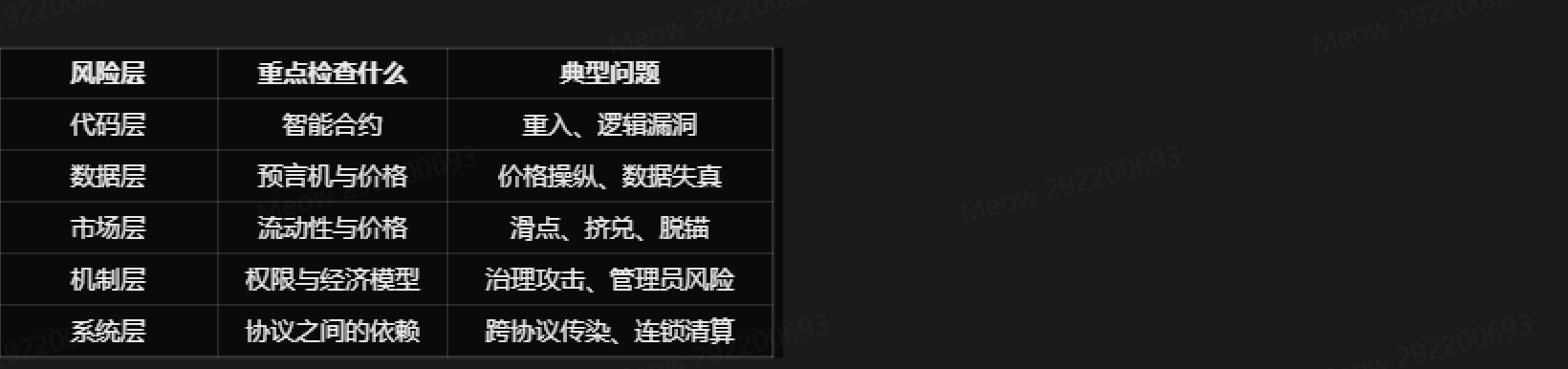
The value of this framework is this: when you come across a new project, you do not need to decide which "attack" it belongs to first. You look for risk entry points layer by layer instead.
How Can Ordinary Users Run a DeFi Security Check?
If you are about to use a DeFi protocol for the first time, check it in this order:
Step 1: Verify the Entry Point
Do not click unfamiliar links in social media. Go in through the project's official website, a trusted wallet or a channel you have already verified.
Step 2: Verify the Contract
Check whether the contract address you are interacting with matches official information. For airdrops, mints and claims in particular, do not rely on the page name alone.
Step 3: Check Approvals
If an operation requires Token Approval, confirm who is being approved and for how much. Do not habitually grant unlimited allowances when it is not necessary.
Step 4: Understand the Signature
If the signature or transaction content in the wallet pop-up makes no sense to you, do not confirm it just because "everyone is clicking it".
In 2026 the Ethereum ecosystem is pushing forward with initiatives such as Clear Signing, whose core idea is to let wallets present transaction intent to users in a form that is easier to understand. In many real attacks, the final step that moved the assets was not the user deliberately handing assets to an attacker, but the user confirming a transaction they did not truly understand.
Step 5: Check Permissions
Confirm whether the project holds special permissions such as upgrading, pausing, changing parameters or moving assets. The more concentrated the permissions, the more you need to look at key management, multisig and timelocks.
Step 6: Consider the Worst Case
Do not only ask how much the project can earn when everything works normally. Also ask:
If the oracle fails, a stablecoin depegs, the contract is paused or liquidity suddenly disappears, how much could I lose at most?
That question usually matters more than comparing APY alone.
What If You Think You Have Already Taken a Dangerous Action?
If you have only connected to a suspicious site, stop transacting first, and do not follow the "support guidance" given by the other side.
If you have already signed a suspicious approval, check and revoke unnecessary Token Approvals as soon as possible. If you suspect your private key or seed phrase has leaked, the original wallet can no longer be treated as safe: stop transferring assets into it immediately and move the remaining assets to a new secure wallet according to your actual situation.
If an on-chain transfer has already happened, keep the transaction hash, wallet address, website domain and chat records. Blockchain transactions are usually irreversible, so claims such as "pay a fee and we can recover your assets" or "pay a deposit and the account will be unfrozen" deserve extra caution to avoid a second scam.
FAQ: Common DeFi Security Questions
Is a DeFi project safe once it has been audited?
Not necessarily. An audit can help uncover some problems in the code and design, but it cannot guarantee that the project will always be safe in the future, and it does not cover malicious front ends, leaked private keys, admin permissions, economic models or user behaviour risk.
Is a flash loan a kind of attack?
No. A flash loan is an on-chain financial instrument. Attackers may use flash loans to obtain a large amount of temporary capital and thereby amplify vulnerabilities in oracles, pricing and liquidation.
Are old approvals still valid after I disconnect my wallet?
They may still be valid. Disconnecting from a website and revoking a Token Approval are two different things. Permissions already granted to a contract do not disappear because you closed the page or disconnected.
Why can a website that looks normal still be risky?
Because what users actually interact with is the web front end, and that front end can be tampered with, imitated or replaced. Even if the underlying smart contract has no flaws, a malicious front end can still lead users into signing the wrong transaction.
What should users guard against most in DeFi security?
For ordinary users the priority order is usually: do not enter fake sites, do not leak private keys or seed phrases, do not sign blindly, do not approve carelessly, verify contracts and counterparties, and check permissions regularly.
Conclusion
DeFi security cannot be reduced to "find a project that has been audited". A real security assessment covers five levels: code, data, market, mechanism and system.
For ordinary users, the most effective precautions are not complicated either: verify the entry point, check the contract, control approvals, understand signatures, protect private keys, and consider the worst case before every operation.
The core logic of DeFi is letting code execute financial rules automatically, and the core of security is making sure that the rules you sign, the permissions you grant and the counterparties you interact with are all things you genuinely understand and are willing to bear.
Risk warning: DeFi assets and related protocols carry significant market, liquidity, smart contract, oracle, governance and systemic risk. Historical security records, audit results and protocol size do not mean that no security incident will occur in the future. Before participating in any on-chain protocol, make sure you fully understand the relevant mechanisms and risks, and make careful decisions based on your own risk tolerance.
If another protocol it depends on runs into trouble, will my assets be affected too?
Recommended
View more