
What Is TVL? The Key Metric for Measuring a DeFi Protocol's Value
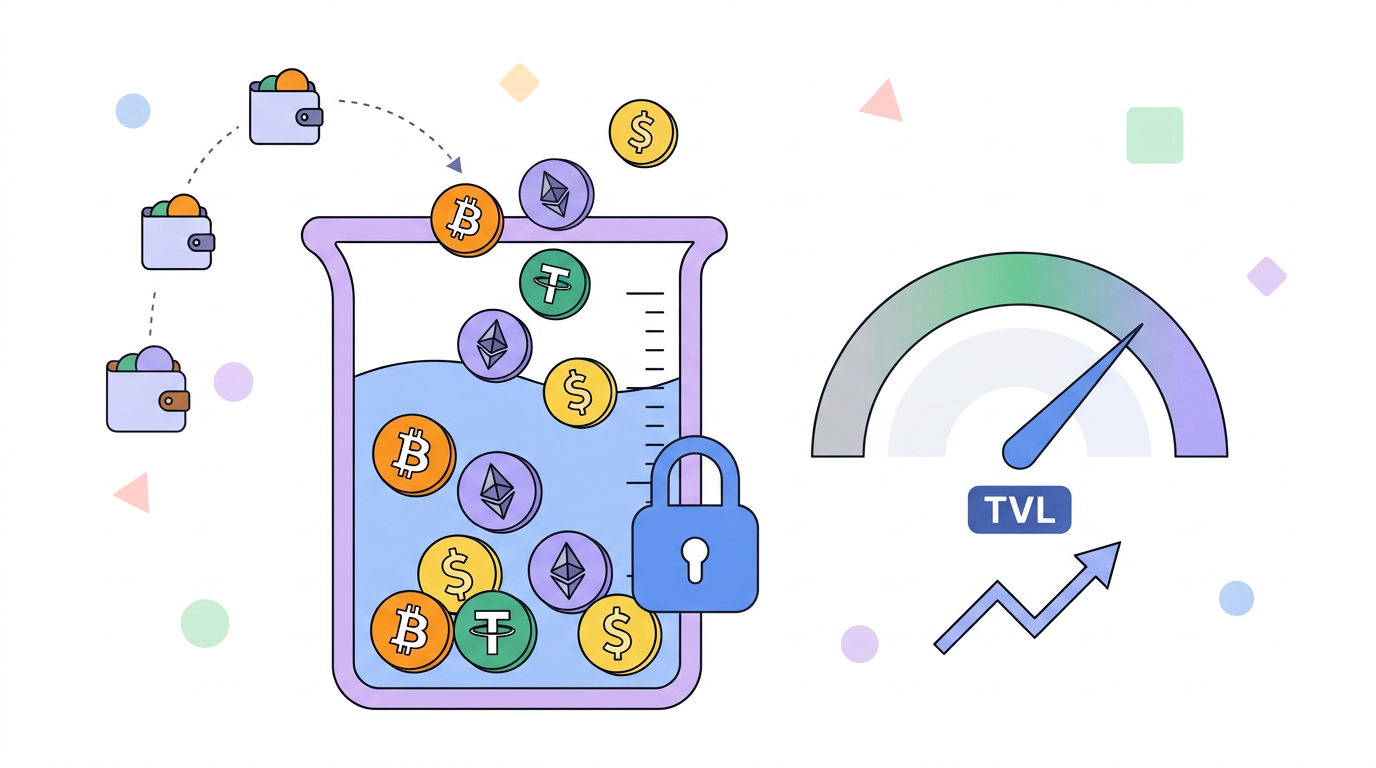
TVL stands for Total Value Locked. It refers to the total value of crypto assets currently locked in or deposited into the smart contracts of a DeFi protocol. It is widely used to gauge the capital scale of a protocol or a DeFi ecosystem, but a higher TVL does not mean a protocol is safer or better, and it does not mean those assets are generating more returns.
What Is TVL in DeFi?
In DeFi, users may deposit assets into a lending protocol, add them to a DEX liquidity pool, use them as collateral, or put them into yield strategies. Once those assets are converted into a common unit of account at current market prices, they make up the protocol's TVL.
For example, suppose a protocol holds:
1,000 ETH, assuming each ETH is worth 3,000 USD;
2 million USDT;
5 million USD of other assets that fit the accounting scope.
In this hypothetical scenario, the protocol's TVL would be roughly 1,000 × 3,000 + 2 million + 5 million = 10 million USD.
TVL is therefore essentially a snapshot of asset scale, not protocol revenue, profit or token market cap.
How Is TVL Calculated?
The simplest way to think about it is:
TVL = the sum of qualifying asset quantities × their current prices
Because protocols differ in how their data is structured, a real calculation also has to decide which contracts, assets and strategies are included, so figures can differ from one data platform to another.
More importantly, TVL is usually denominated in USD or another fiat currency, so it is driven not only by deposits and withdrawals but also by asset price movements.
Take a protocol that has always held 1,000 ETH:
when ETH is 2,000 USD, TVL is about 2 million USD;
when ETH rises to 3,000 USD, TVL is about 3 million USD.
Even with no new deposits during that period, the protocol's TVL still increased by 1 million USD.
This is the most easily overlooked point when analyzing TVL: a rising TVL does not mean users added capital.
Why Does TVL Change?
TVL usually changes for two main reasons: asset price movements and actual inflows or outflows of capital.
1. Asset prices rise or fall
If ETH, BTC or other tokens held by the protocol rise in price, the USD-denominated TVL may increase in step; conversely, even without any user withdrawals, falling prices can bring TVL down quickly.
So a TVL curve alone makes it hard to tell whether users keep depositing funds or whether the assets held simply changed in price.
2. Users actually deposit or withdraw assets
If a large number of users provide liquidity, deposit assets or add collateral, TVL usually increases.
Conversely, when users pull liquidity, repay and withdraw assets, or move funds out of the protocol, TVL may fall.
When analyzing a protocol's capital position, it is therefore best to read TVL together with inflow and outflow data, rather than looking at a single change in TVL.
Does a Higher TVL Mean a Better DeFi Protocol?
You cannot judge that directly. TVL is better suited to measuring a protocol's capital scale than to assessing its quality on its own.
A high TVL usually means more assets have settled in the protocol, which is useful when judging scale, market participation and the liquidity base.
But ranking protocols by TVL alone easily overlooks a few key issues:
First, TVL does not represent real usage.
A protocol may lock up a large amount of assets while actual trading, lending or other business activity stays quiet.
Second, TVL does not represent protocol revenue.
A protocol can hold a very high TVL, but if trading volume and user activity are limited, the fees and revenue it generates may not be high.
Third, TVL can be shaped by incentives.
If a protocol attracts liquidity with generous token rewards, users may deposit assets temporarily to capture those rewards. Once incentives fade, part of that capital may leave just as quickly.
TVL is therefore better understood as a scale metric than as a quality score.
Does a High TVL Mean the Protocol Is Safer?
Again, no.
TVL reflects how many assets fall within the protocol's accounting scope, but it cannot tell you how much smart contract, oracle, governance or market risk those assets face.
Even a protocol with a very high TVL may still have:
smart contract vulnerabilities;
abnormal oracle prices;
failing liquidation mechanisms;
privileged access control risks;
insufficient liquidity;
bridge or third-party protocol risks.
TVL is thus better at answering "how much capital does this protocol currently hold" than "is it safe to put assets in".
What Is the Difference Between TVL and Inflows?
This is the single most useful distinction for understanding TVL.
Suppose a lending protocol originally locked 100 million USD of ETH. ETH then rises 20%, with no new deposits and no withdrawals.
The protocol's TVL may rise from 100 million to 120 million USD.
That does not mean the protocol truly received 20 million USD of new capital.
Conversely, if ETH falls 20%, TVL may decline even though users did not actually withdraw funds.
Therefore:
A change in TVL does not equal net capital inflows or outflows.
Some professional data platforms go further and provide metrics such as USD Inflows, which track the actual capital movement behind changes in asset balances, helping separate price-driven TVL changes from users genuinely adding or removing capital.
Why Can't You Simply Compare TVL Across Protocols?
Different types of DeFi protocols have different business models and asset structures.
For example, a DEX's TVL is mostly tied to liquidity pools; a lending protocol's TVL relates to deposits and collateral; a stablecoin protocol may involve collateral assets and its issuance mechanism.
So "Protocol A has 10 billion USD TVL, Protocol B has 5 billion, therefore A must be better than B" does not hold.
A more reasonable approach is:
compare within the same category, review historical trends, and factor in business data.
When comparing two lending protocols, for instance, you can also look at:
TVL scale;
TVL trend;
borrow volume;
capital utilization;
user activity;
protocol fees and revenue;
incentive mechanisms;
smart contract and governance risks.
That way you avoid treating one metric as a complete evaluation system for a protocol.
If you are not yet familiar with what DEXs, lending, stablecoins and derivatives each are, start with The Core Components of DeFi: DEX, Lending, Stablecoins and Derivatives and then revisit what TVL means for each type of protocol.
Four Things to Check When Judging a DeFi Protocol's TVL
For ordinary users, there is no need to start with complex data models. You can work through the following order:
First, look at absolute scale.
Confirm roughly how much TVL the protocol holds, and whether it is a large, mid-sized or small protocol.
Second, look at the trend.
Do not fixate on today's figure. Look at the past 7 days, 30 days or even longer to see whether capital scale is steadily rising or falling fast.
Third, look at asset composition.
A 10 billion USD TVL made up mainly of illiquid, highly volatile assets has a very different risk profile from one built on major stablecoins and highly liquid assets.
Fourth, look at data beyond TVL.
Combining trading volume, borrow volume, fees, revenue, active users and capital inflows and outflows gives a fuller picture of how the protocol actually runs.
A Simple Framework
Think of TVL as answering the first question:
"How much money is in this protocol right now?"
Then keep asking:
"Who put that money in?"
"Is that money still flowing in?"
"What are those funds being used for?"
"Does the protocol have genuine usage demand?"
"What risks are those funds exposed to?"
Using TVL this way is far more meaningful than simply hunting for the protocol with the highest TVL.
TVL, Market Size and Protocol Value Are Not the Same Thing
TVL is easily confused with market cap, protocol revenue and similar concepts, yet they measure completely different things.
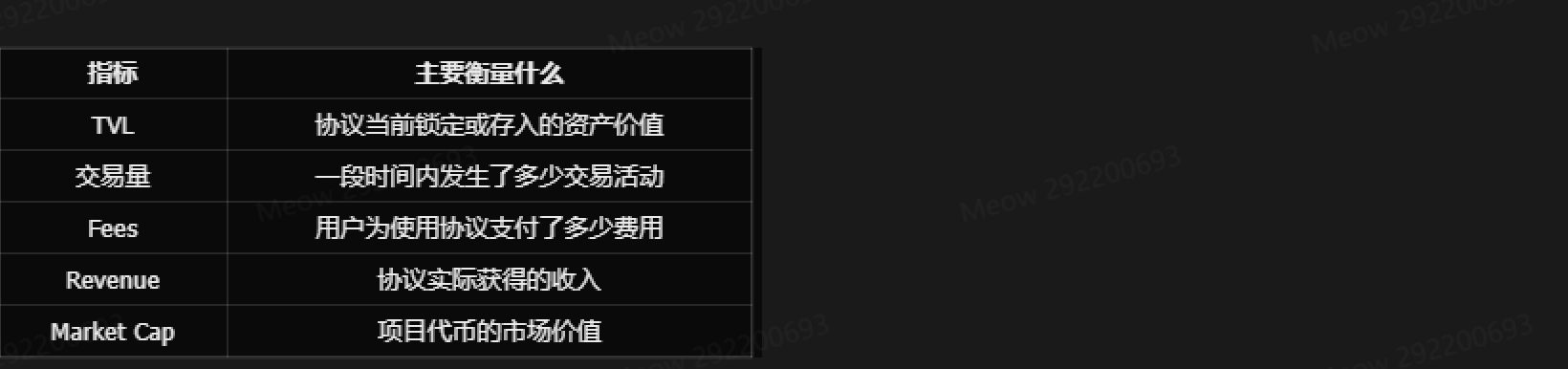
As a result, a protocol may have a very high TVL but modest revenue, or a TVL that is not the highest while its trading activity is strong.
Truly valuable analysis is not about finding one universal metric, but about understanding how different metrics relate to each other.
How Should Beginners Understand TVL?
If you remember only one sentence, remember this:
TVL is an important measure of a DeFi protocol's capital scale, but it is not the only standard for judging its safety, profitability or investment value.
When TVL rises, do not jump to the conclusion that users are flooding in; first check whether the underlying assets simply rose in price.
When TVL falls, do not assume users are rushing to withdraw; you also need to separate price effects from actual capital movement.
For DeFi beginners, the most practical habit is to treat TVL as an entry-level metric: use it to understand a protocol's scale first, then add capital flows, business activity, revenue and risk information before making a further judgment.
FAQ
What does TVL mean?
TVL stands for Total Value Locked. It measures the total value of crypto assets currently locked in or deposited into a DeFi protocol.
Does a higher TVL mean greater safety?
Not necessarily. TVL mainly reflects capital scale and cannot on its own reflect smart contract, oracle, governance or liquidity risks.
Does a rising TVL mean capital is flowing in?
Not necessarily. Because TVL is usually calculated at current asset prices, rising prices for ETH, BTC and other assets can also push TVL up without any corresponding new capital inflow.
What is the difference between TVL and market cap?
TVL measures the value of assets locked in or deposited into a protocol; market cap usually refers to the market value of a project's token. They are different metrics.
How can I tell whether a DeFi protocol's TVL is healthy?
Do not look at the TVL number alone. Also review historical trends, asset composition, actual inflows and outflows, trading or lending activity, fee revenue and protocol risks.
Risk Disclosure
DeFi protocols involve multiple risks, including smart contracts, digital asset price volatility, liquidity, oracles, governance and the broader market. TVL can only serve as a reference for a protocol's scale and capital position; it is not a guarantee of safety, yield or future performance. Before participating in any DeFi product, assess the protocol's mechanisms and related risks independently, in light of your own risk tolerance.
Recommended
View more