Crypto Exchange for Beginners: From Sign-Up to Your First Trade
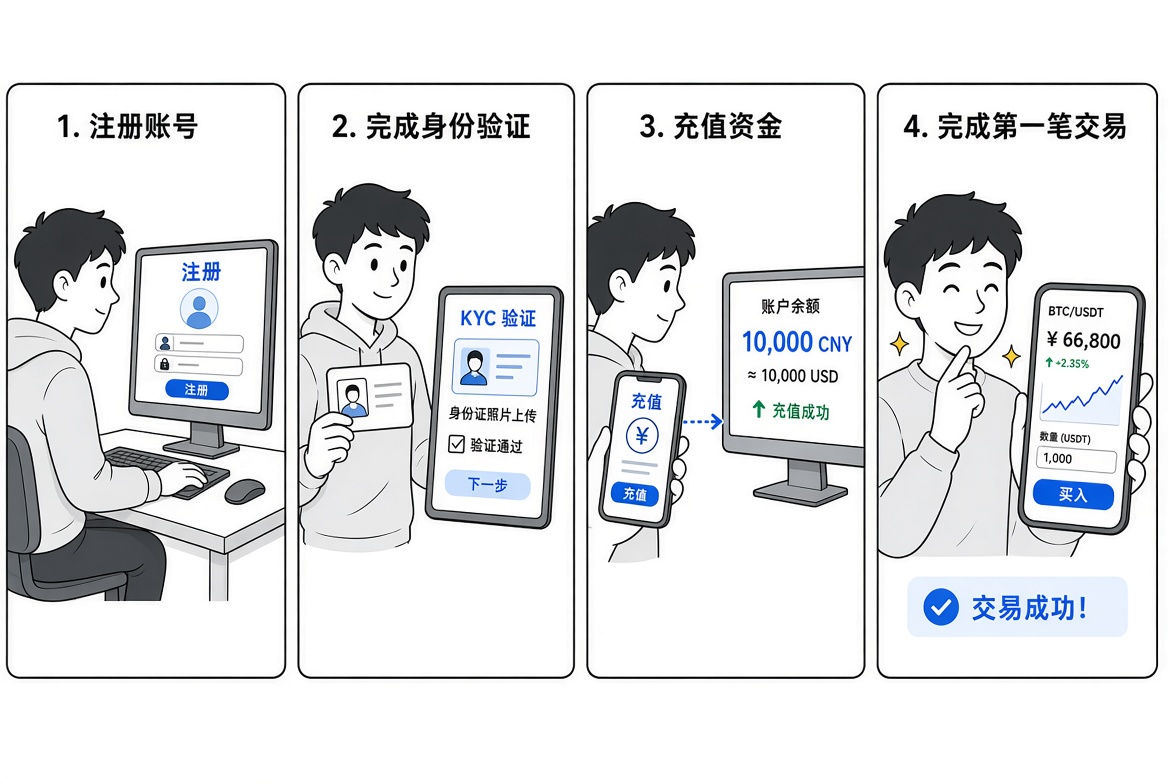
When you use a crypto exchange for the first time, the full path usually looks like this: choose an exchange → register an account → complete identity verification → set up account security → fund the account → choose spot trading → choose a trading pair and order type → check the fees → complete your first trade. Beginners do not need to start with contracts, leverage or quantitative strategies; once you understand this basic route, you can complete a reasonably full trading experience.
What should you understand first about using a crypto exchange?
A crypto exchange can be understood as a platform that offers digital asset trading and asset management services, where users can register an account, deposit funds, trade on the spot market and withdraw assets. For a first-time user, the most important thing is not to memorise every feature, but to work out where your money sits, what you are trading, how to place an order and how to move assets out.
If you use a centralised exchange (CEX), the platform usually provides an account system, order matching, asset management and security verification. Compared with using an on-chain wallet directly, a CEX normally has a lower barrier to entry, but users still need to protect their account, login credentials and withdrawal permissions carefully.
If you want to understand how a CEX works in more depth, read What Is a Crypto Exchange? A Beginner's Guide to CEX first, then move on to the practical steps.
After registering an exchange account, what should you do first?
Once registration is complete, it is best to finish identity verification and account security settings before moving any funds. Identity verification is usually required to meet the platform's compliance obligations, while security settings directly affect account login, withdrawals and risk control over abnormal activity.
For security, check your login password, two-factor authentication and account binding details first, and make sure you are using official channels. Do not rush to move a large amount of funds into the account just because registration was quick; on your first attempt it makes more sense to get familiar with the pages and the process, then run a small test.
If you have not decided which exchange to use, see Comparing and Choosing the Mainstream Global Crypto Exchanges, and compare tradable products, fees, deposit methods, withdrawal conditions, security mechanisms and regional availability rather than rankings alone.
What is the difference between fiat deposit and crypto deposit?
Both a fiat deposit and a crypto deposit involve moving funds into your trading account, but for beginners it helps to separate the two scenarios: a fiat deposit answers how cash enters the crypto trading process, while a crypto deposit moves assets you already hold, such as BTC or USDT, from an external wallet or another platform into the exchange.
If you already hold digital assets such as USDT, you can transfer them into your trading account through the relevant deposit function. If you only hold fiat currency such as RMB, you need to buy or deposit according to the methods the platform currently supports. Whichever route you take, confirm the coin, the amount and the related fees first, and do not treat "depositing", "buying coins" and "spot trading" as one single step.
If you need to understand how fiat currency enters the crypto trading process, continue with A Complete Guide to Fiat Deposits: How to Buy Crypto with RMB.
Why is it best to start with spot trading for your first trade?
Spot trading is one of the easiest trading methods for beginners to understand, because what you actually receive after a fill is the corresponding digital asset. For example, in the BTC/USDT pair, after buying BTC with USDT your USDT balance falls and your BTC balance rises; that is a typical spot trade.
Your first trade does not need leverage or contracts. Understanding trading pairs, account balances and the relationship between buying and selling, and then getting to grips with order types, helps you build basic trading skills and also avoids taking on extra risk from margin, leverage and liquidation mechanisms you do not yet understand.
If you want to learn more about spot trading, see What Is Spot Trading? The Simplest Way to Buy Crypto.
Which parts of the trading page should you focus on?
When you open the trading page for the first time, you do not need to understand every indicator; just locate the four core areas: the trading pair, price and market data, the order book, and the buy/sell order panel. The trading pair determines which two assets you are trading, the market area helps you watch price movements, the order book shows the current buy and sell orders on the market, and the order panel is where you actually submit a trade.
Choosing BTC/USDT, for example, means BTC is the asset you are buying and selling while USDT is the quote asset. After confirming the pair, check your available balance and the quantity you plan to buy or sell, and only then move on to choosing an order type and submitting the order.
If the various areas of the trading page are still unfamiliar, start with Exchange Interface Explained: Read the Trading Page in 5 Minutes.
Market order or limit order: how do you choose?
A market order prioritises getting filled, and normally executes at the best price currently available on the market. A limit order prioritises controlling the price: you set the price you are willing to accept, and the order can only fill when the market reaches that condition.
If your main goal is to complete a small test trade as quickly as possible, a market order is usually easier to understand, though the actual fill price may be affected by market liquidity and price movement. If the fill price matters more to you and you want to buy or sell at a specific level, consider a limit order, bearing in mind that a limit order is not guaranteed to fill.
To judge when each order type suits you better, read Market Order vs Limit Order: How to Choose Your Order Type.
What costs should you check before your first trade?
Before your first trade, you should at least confirm the trading fee, the bid-ask spread, and any deposit or withdrawal costs. The trading fee is usually calculated from the filled amount and the applicable rate, while your real trading cost can also be affected by market liquidity and slippage, so do not look only at whether the asset price rises or falls.
For example, the base fee on a trade can be understood as "filled amount × applicable fee rate". If you buy and sell frequently, even a fee that looks small on a single trade can gradually affect your results once accumulated, so confirming the currently applicable rate before submitting an order is a habit worth building.
For a detailed look at trading costs, see Trading Fees Explained: How to Read a Fee Schedule.
After your first trade is complete, what comes next?
Once the order fills, confirm your asset balances and trade history first rather than immediately placing the next trade. Check whether the quantity of the asset you bought, the fill price and the fees actually deducted match your expectations; this step helps you get used to how balances and order records change on an exchange.
If you do not need to move the assets out yet, you can leave them in the account and watch. If you need to transfer digital assets to another exchange or a personal wallet, you enter the withdrawal process. When withdrawing, be especially careful to confirm that the coin, the withdrawal address and the network all match exactly, because choosing the wrong network can prevent the assets from arriving.
If you are ready to move assets out, see How to Withdraw Crypto: The Full Cash-Out Process to learn what to check first.
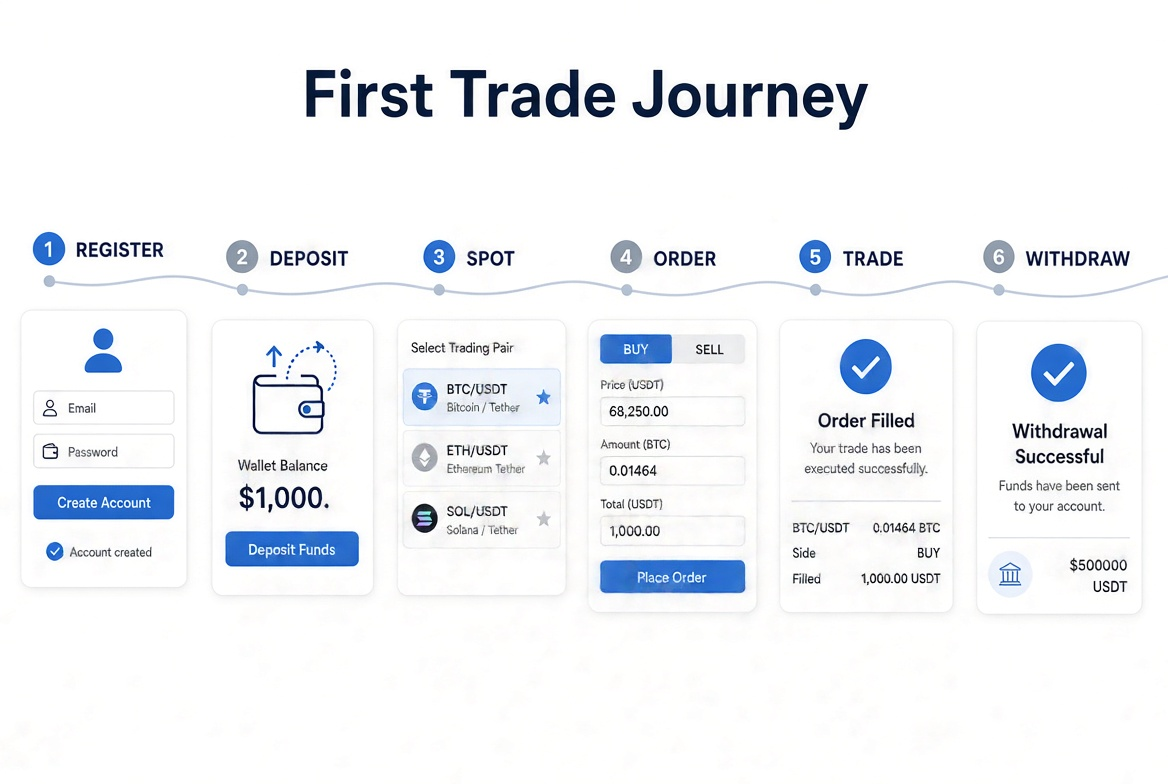
A complete checklist for a beginner's first trade
Condensing the entire process, you can confirm each item against the checklist below before your first trade:
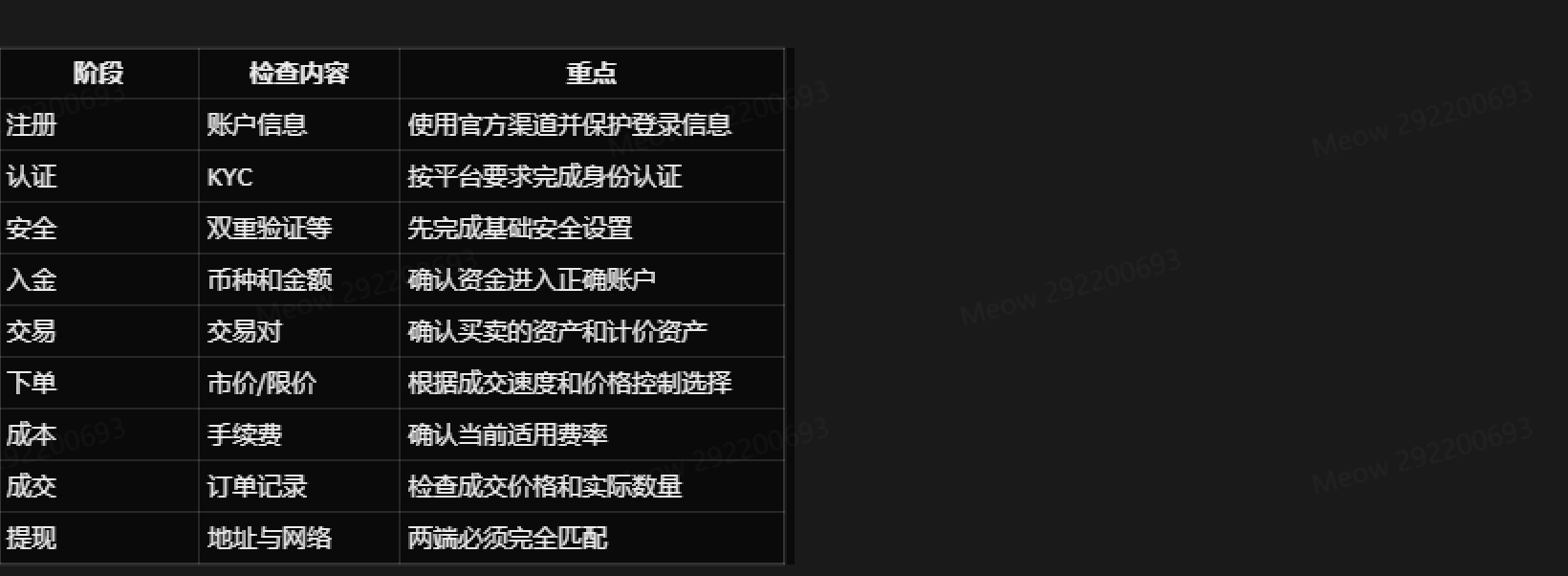
The value of this checklist is that it separates the steps beginners confuse most often: account preparation, funding, trade execution and moving assets out are four different stages. As long as you finish each stage before starting the next, mistakes are easier to control than clicking around the trading page from the very beginning.
FAQ
For a first crypto purchase, should a beginner choose spot or contracts?
If the goal is simply to complete a first trade and understand how buying and selling digital assets works, spot is usually the easier starting point. Contracts involve additional mechanisms such as margin, leverage, funding rates and liquidation, and are not suitable to try blindly before you understand basic spot trading.
Do you have to deposit right after registering on an exchange?
No. A more sensible order is to finish your account security settings, get familiar with the trading page, order types and fee rules, and only then decide whether to move funds. For the first time, you can also test the whole process with a smaller amount.
Will a market order always fill at the price I saw?
Not necessarily. A market order aims to fill quickly, but the actual fill price can be affected by order book depth, market volatility and order size, so the price shown on the page and the final fill price may differ.
Can I withdraw immediately after buying?
Whether you can withdraw depends on the platform's current asset, account and withdrawal rules. In some cases there may also be minimum withdrawal amounts, network status, security verification or other restrictions, so before withdrawing you should rely on the specific conditions shown on the current page.
How much should you buy on your first trade?
There is no fixed amount that suits everyone. On your first use of an exchange, getting familiar with the whole process matters more, so consider starting with a small amount you can afford to lose, rather than putting in more than your risk tolerance allows because a particular asset has risen recently.
Risk notice
Crypto asset prices are volatile and trading can result in a loss of principal. Market orders may be affected by slippage, limit orders may not fill, and withdrawals carry operating risks related to addresses, networks, fees and settlement. Before trading with real funds, make sure you fully understand the product rules and decide carefully based on your own risk tolerance.
Inirerekumendang pagbabasa
Tingnan ang higit pa